
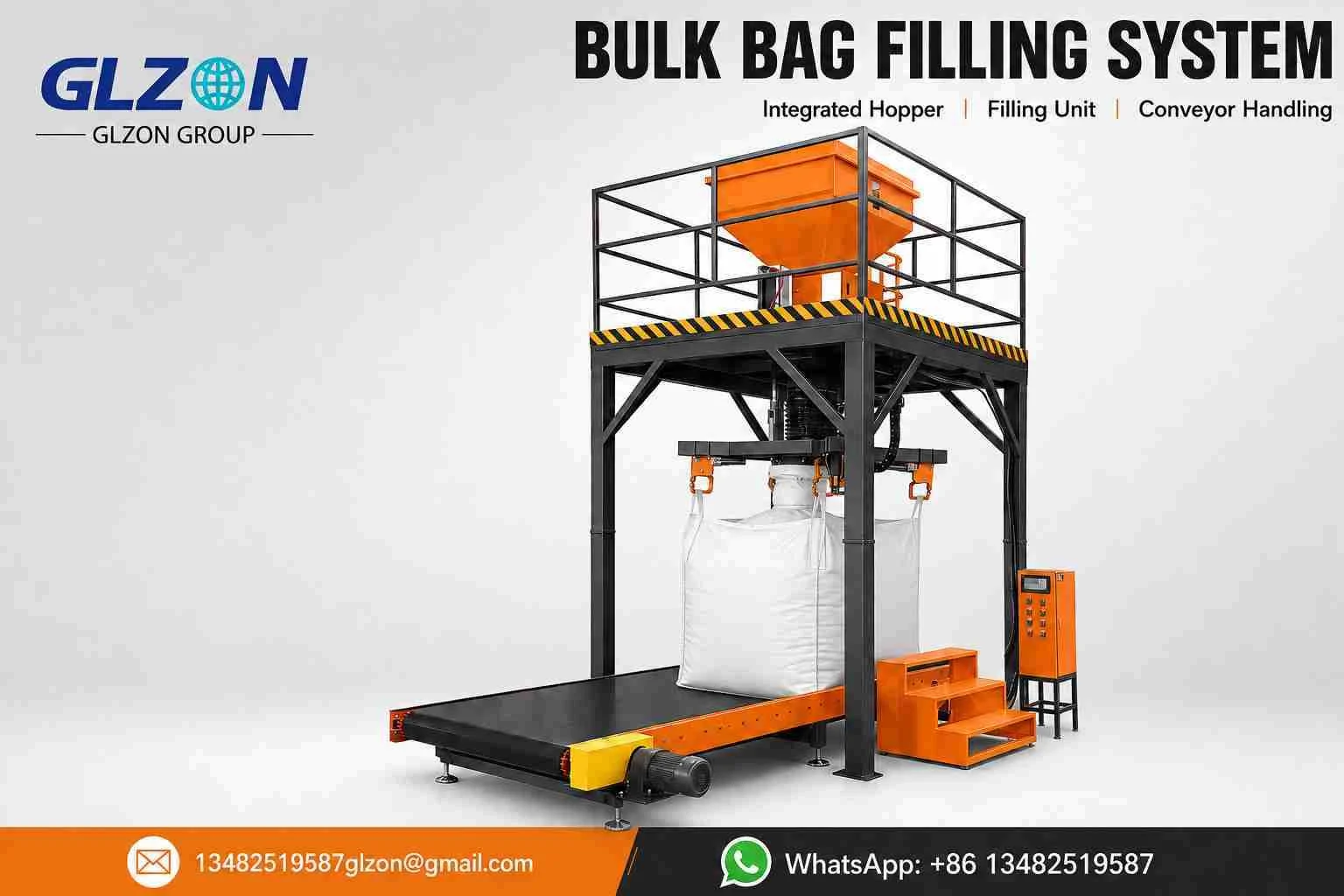
Bulk Bag Filling Systems: How to Select the Right Equipment
A bulk bag filling system should be selected around the material, production process and operating environment—not simply the nominal capacity of the bag.
The right solution must accommodate the material’s flow characteristics, achieve the required filling rate, control weight accurately and integrate with the way empty and filled bags move through the facility. Dust control, available headroom, cleaning requirements and future production needs should also be evaluated before equipment is specified.
This guide explains the essential technical and commercial factors to consider when choosing a system for FIBC, jumbo bag, big bag, ton bag or super sack filling.
What Is a Bulk Bag Filling System?
A bulk bag filling system is industrial equipment designed to load dry bulk materials into flexible intermediate bulk containers, commonly known as FIBCs.
The same equipment may also be described as a:
- Bulk bag filler
- FIBC filling machine
- Big bag filling machine
- Jumbo bag filler
- Ton bag filler
- Super sack filler
Although these terms are often used interchangeably, the correct machine configuration depends on the material, bag construction, target weight and required production capacity.
A complete system may include:
- Product hopper
- Controlled feeding device
- Structural support frame
- Filling head
- Bag-loop supports
- Load-cell weighing system
- Electronic weighing controller
- Dust-extraction connection
- Bag inflation or deaeration
- Product densification
- Pallet or roller conveyor
- Filled-bag handling equipment
Not every application requires every component. A professional system should include only the equipment needed to achieve the required filling, handling, cleanliness and safety objectives.
How the Filling Process Works
A typical filling cycle follows a straightforward sequence:
- An empty pallet and FIBC bag are positioned beneath the machine.
- The bag’s lifting loops are secured to the support arms.
- The inlet spout is connected to the filling head.
- Material enters the bag through the selected feeding device.
- Load cells monitor the increasing weight.
- The controller slows and stops the feeder at the target weight.
- The filled bag is released and transferred to the next process.
Depending on the application, the process can be manual, semi-automatic or integrated into a fully automated material-handling line.
Start With the Material
Material behavior is the foundation of equipment selection. Two products with similar names may require very different hopper, feeder and filling-head designs.
Before requesting a quotation, define the following characteristics:
| Material property | Why it matters |
|---|---|
| Physical form | Determines whether the product behaves as a powder, granule, pellet, flake or mixed material |
| Bulk density | Establishes the bag volume required for the target weight |
| Flowability | Influences hopper and feeder selection |
| Particle size | Affects product flow, dust generation and sealing |
| Moisture content | May increase sticking, bridging or compaction |
| Abrasiveness | Influences material selection and wear protection |
| Aeration | Can increase bag volume and reduce stability |
| Fragility | Determines how gently the material must be handled |
| Corrosiveness | May require stainless steel or another compatible material |
| Dust characteristics | Influences containment and extraction requirements |
If the product bridges inside a hopper, sticks to contact surfaces or changes density during handling, a material test can provide valuable design information.
Why bulk density matters
Bulk density determines how much space a given material weight will occupy.
A dense mineral may reach 1,000 kg before the bag is fully expanded. A lightweight powder may fill the available bag volume before it reaches the same weight.
For this reason, a “one-ton bag” is not a universal size. The bag dimensions must be selected using both the target weight and the material’s loose and settled bulk density.
Confirm the Bag Specification
The filling machine must fit the actual bag rather than a general bag description.
Provide the equipment manufacturer with a bag drawing that identifies:
- Bag width, length and height
- Rated working capacity
- Filling-spout diameter and length
- Number and position of lifting loops
- Discharge-spout dimensions
- Coated or uncoated construction
- Internal liner, if present
- Pallet dimensions
If several bag sizes will be used, the filling frame may require adjustable support arms, filling-head height adjustment or interchangeable components.
The minimum and maximum dimensions should be confirmed before the machine is manufactured.
Calculate the Required Filling Capacity
Production requirements are normally expressed as bags per hour or tonnes per hour.
The minimum theoretical filling rate can be calculated as follows:
Required bags per hour = hourly material output ÷ target bag weight
For example, a process producing 15 tonnes per hour and filling 1,000 kg bags requires a minimum theoretical rate of 15 bags per hour.
The actual filling rate will also depend on:
- Material flow
- Feeder capacity
- Bag installation time
- Coarse and fine filling stages
- Product settling
- Densification time
- Filled-bag removal
- Operator efficiency
- Cleaning and product changes
A system should include sufficient reserve capacity for normal operating interruptions. Buyers should ask whether the quoted output is theoretical, calculated or demonstrated using a comparable material.
Select the Correct Feeding Technology
The feeding device controls the movement of material from the hopper or upstream process into the bag.
| Feeder type | Suitable applications | Primary advantage |
| Gravity feeder | Free-flowing granules and pellets | Fast, simple material transfer |
| Screw feeder | Powders and difficult-flowing products | Controlled and consistent feeding |
| Belt feeder | Granules, flakes and fragile materials | Gentle handling |
| Vibratory feeder | Free-flowing granular materials | Controlled final dosing |
| Rotary valve | Powders supplied from a silo or pneumatic system | Consistent product transfer |
Gravity feeding
Gravity feeding can be an efficient solution when the material flows freely and can be stopped reliably by a gate or valve.
Screw feeding
A screw feeder is commonly used for powders and materials requiring controlled flow. Variable-speed operation can provide a fast initial fill followed by a slower final feed as the target weight approaches.
Belt feeding
Belt feeders are often considered for fragile materials that may be damaged by aggressive mechanical handling.
Vibratory feeding
Vibratory feeders can provide controlled dosing for many granular products, particularly during the final stage of the filling cycle.
The most suitable feeder should be determined by the material’s actual behavior, required accuracy and production capacity.
Define the Filling-Accuracy Requirement
Accurate filling reduces product giveaway and helps maintain consistent finished-bag weights.
A typical weighing system uses load cells beneath the filling frame or supporting platform. The controller continuously monitors the bag weight and stops the feeder when the programmed target is reached.
Many systems use two-stage filling:
- A high-speed coarse feed delivers most of the material.
- A slower fine feed completes the final portion with greater control.
Filling accuracy can be affected by:
- Variations in bulk density
- Inconsistent material flow
- Feeder stopping response
- Material remaining in the chute
- Product aeration
- External vibration
- Load-cell selection
- Controller programming
- Calibration
- Installation conditions
Ask the supplier to define the expected performance using your material, bag weight and filling rate. A general accuracy statement has limited value unless the operating conditions are also specified.
Choose the Appropriate Automation Level
The most advanced system is not always the most suitable. Automation should be selected according to production demand, labor availability and the required level of process integration.
| Configuration | Typical operator involvement | Best suited to |
| Manual | Operator positions, connects and controls the bag | Lower-volume or flexible production |
| Semi-automatic | Operator installs the bag; filling and weighing are automatic | Medium-volume production |
| Automatic | Filling is integrated with conveyors and material handling | High-volume continuous production |
Manual systems
Manual equipment can provide an economical solution for lower production volumes or applications with frequent bag and product changes.
Semi-automatic systems
Semi-automatic bulk bag fillers combine manual bag installation with controlled feeding and automatic weighing. They often provide an effective balance between productivity, flexibility and investment.
Automatic systems
An automatic line may include:
- Pallet dispensing
- Powered conveyors
- Programmable filling cycles
- Automatic bag inflation
- Integrated weighing controls
- Production-data recording
- Communication with upstream and downstream equipment
Automatic equipment is most valuable when reduced operator handling or continuous production provides a measurable operational benefit.
Control Dust and Displaced Air
Dust control is an important consideration when filling powders and other fine materials.
As material enters the bag, displaced air must escape. If this air is not managed correctly, it can carry dust into the surrounding work area.
Depending on the application, the system may include:
- Inflatable filling-spout seal
- Dust-extraction connection
- Enclosed product-transfer points
- Bag inflation
- Product deaeration
- Flexible containment
- Cleanable product-contact surfaces
An inflatable seal creates a controlled connection between the bag and filling head. A properly designed extraction system can help remove displaced air and collect airborne particles.
Materials that create combustible or hazardous dust require a qualified, application-specific safety assessment. Equipment must comply with the standards and regulations applicable to the installation.
Consider Settling and Densification
Aerated and low-density materials can occupy excessive volume after filling. The result may be an unstable bag that is difficult to store, stack or transport.
Available densification methods can include:
- Vibrating support platform
- Bag-bottom massage
- Controlled filling speed
- Product deaeration
- Repeated filling and settling stages
Densification can improve bag shape and stability, but the method must be compatible with the material. Excessive vibration may damage fragile products or separate mixed materials.
Review the Factory Layout
Equipment performance depends on how effectively the filler integrates with the surrounding process.
Before finalizing the design, confirm:
- Available ceiling height
- Floor space
- Material inlet position
- Hopper or silo location
- Forklift access
- Pallet dimensions
- Conveyor direction
- Operator workspace
- Maintenance access
- Cleaning access
- Electrical supply
- Compressed-air supply
- Dust-extraction connection
- Space for future expansion
The movement of empty and filled bags should also be reviewed. A fast filling machine will not achieve its intended output if pallet placement or filled-bag removal creates a bottleneck.
A dimensional factory drawing can help identify installation conflicts before equipment manufacturing begins.
Select Suitable Construction Materials
Construction materials should be compatible with the product, cleaning process and operating environment.
Painted carbon steel
Painted carbon steel can be suitable for many general industrial applications involving non-corrosive materials.
Stainless steel
Stainless steel may be appropriate when:
- Product hygiene is important
- Frequent washing is required
- The material is corrosive
- Contamination must be minimized
- The operating environment is wet or chemically aggressive
A system may use stainless steel for product-contact components and painted carbon steel for the structural frame. The equipment proposal should clearly identify all product-contact materials.
Optional Equipment and System Integration
A bulk bag filling system can be configured with additional equipment to meet specific process requirements:
- Surge hopper
- Controlled feeder
- Bag inflation system
- Dust extraction
- Densification platform
- Pallet dispenser
- Roller or chain conveyor
- Operator access platform
- Metal detector
- Checkweigher
- Production-data collection
- Upstream and downstream controls
Each option should serve a defined purpose. Adding unnecessary equipment can increase cost and maintenance without improving performance.
Essential Information for a Quotation
A professional equipment enquiry should include:
- Material name and physical form
- Loose and settled bulk density
- Target weight per bag
- Bag drawing and dimensions
- Required bags or tonnes per hour
- Acceptable filling-weight tolerance
- Method of supplying material to the filler
- Dust-control requirements
- Preferred automation level
- Construction-material requirements
- Available floor space and headroom
- Method of removing filled bags
- Electrical and compressed-air specifications
- Cleaning and product-change requirements
- Applicable safety or industry standards
Providing this information allows the supplier to prepare a more accurate technical proposal and reduces the risk of costly changes later.
Questions to Ask Before Purchasing
When comparing bulk bag filling equipment, ask the supplier:
- Has the proposed system handled a similar material?
- Can a material test be performed?
- How was the stated production rate calculated?
- What filling accuracy can be expected under our conditions?
- Can the frame accommodate different bag sizes?
- Which components will contact the product?
- What dust-control equipment is included?
- Can the controls integrate with existing machinery?
- What installation support is available?
- Is operator and maintenance training included?
- Which spare parts should be kept on site?
- What technical documentation and after-sales support are provided?
A technically complete proposal is more valuable than a quotation based only on machine price.
Frequently Asked Questions
Are bulk bag fillers and FIBC filling machines the same?
In most applications, yes. Bulk bag filler, FIBC filling machine, big bag filler, jumbo bag filler, ton bag filler and super sack filler are common names for the same general equipment category.
How many bulk bags can a machine fill per hour?
Capacity depends on the target weight, feeder output, material behavior, weighing cycle, bag installation and completed-bag removal. The rate should be calculated for the complete operating cycle rather than the material-flow time alone.
Can one filling machine handle different bag sizes?
A machine may accommodate several bag sizes when its frame, filling head and loop supports are adjustable. The complete range of bag dimensions must be reviewed before compatibility can be confirmed.
Which feeder is most suitable for powder?
Screw feeders are widely used for powders because they provide controlled flow. However, the correct choice depends on density, flowability, dust generation, required capacity and filling accuracy.
When should an automatic system be considered?
Automatic equipment is generally considered when production volume is high, operator handling must be reduced or the filler needs to integrate with other processing and conveying equipment.
Is dust extraction always required?
Not every material requires the same level of dust control. Fine powders and aerated products commonly benefit from a sealed filling connection and extraction system. The final design should follow a material-specific dust and safety assessment.
Request a Bulk Bag Filling System Proposal
A reliable filling system begins with a clear understanding of the material and production process.
To discuss your application, send GLZON Group the following details:
- Material name
- Bulk density
- Target bag weight
- Bag dimensions
- Required filling rate
- Accuracy requirement
- Factory layout
- Preferred automation level
GLZON Group can review the application information and discuss a suitable filling, weighing and bag-handling configuration.