
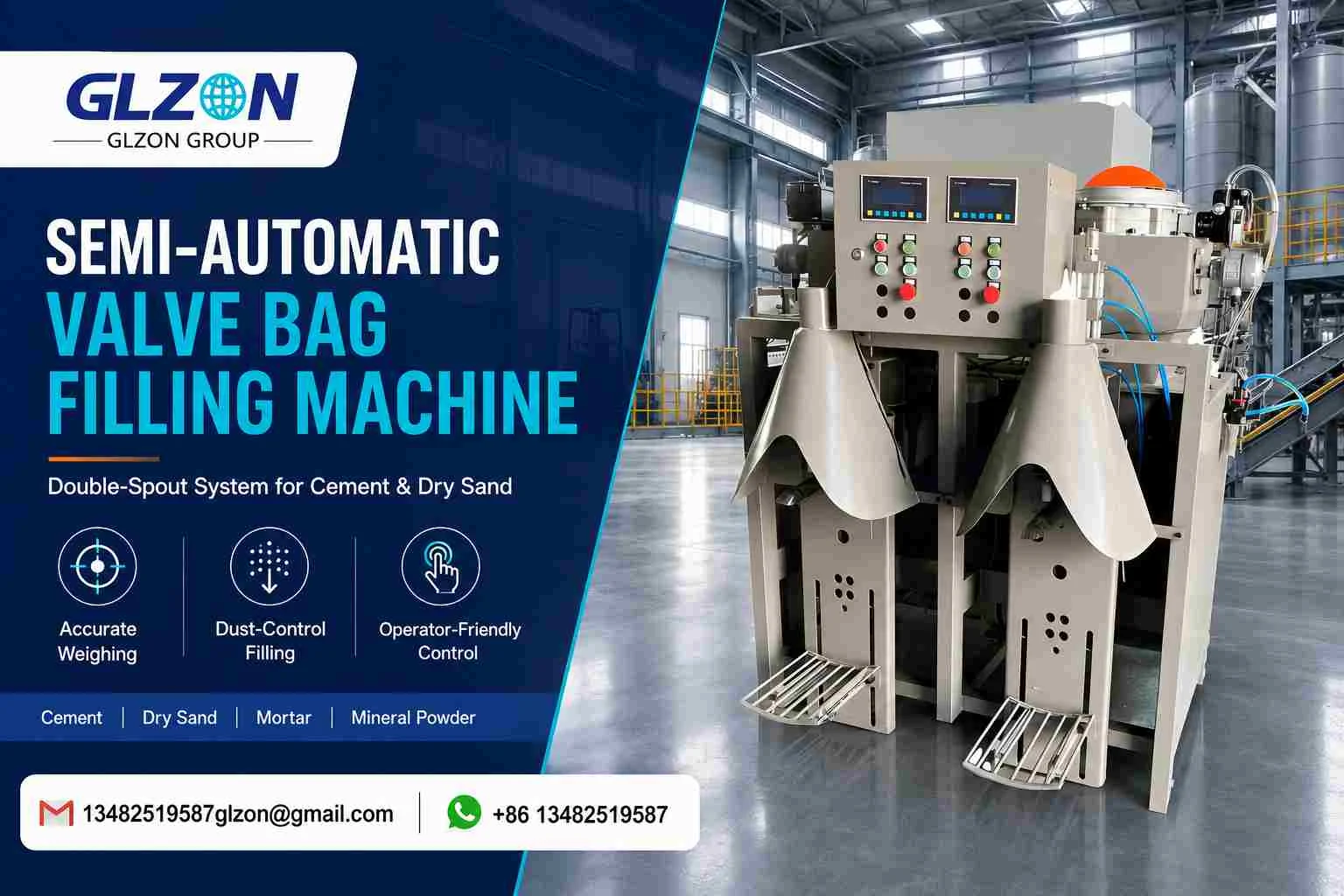
Valve Bag Filling Machine for Cement and Sand: A Practical Buyer’s Guide
A valve bag filling machine weighs and packs cement, dry sand, mortar, mineral powder and similar materials into industrial valve bags. Available configurations can typically handle bags from 10 to 50 kg, with an approximate output of 200 to 600 bags per hour and a typical weighing deviation of 0.2 to 0.5 percent.
The correct machine cannot be selected by production speed alone. Material flowability, bulk density, bag construction, target weight, dust-control requirements and factory layout all affect performance.
This guide explains how valve bag filling equipment works, how single and double-spout machines differ and what buyers should confirm before requesting a quotation.
Quick Machine Selection Summary
| Production requirement | Recommended starting configuration |
|---|---|
| Limited space and moderate output | Compact single-spout machine |
| Continuous production | Double-spout valve bag filler |
| Fine or dusty cement powder | Enclosed filling area with dust extraction |
| Difficult-flowing material | Material-specific feeding system |
| Reduced manual handling | Conveyor and automatic bag-handling system |
| Complete automation | Filling, checking, conveying and palletizing line |
This table provides an initial direction only. A final recommendation should be based on material and bag testing.
What Is a Valve Bag Filling Machine?
A valve bag filling machine is industrial equipment that introduces a measured quantity of powder or fine granular material through a small opening in a valve bag.
The operator places the bag valve over the filling spout. The machine feeds the material, monitors its weight and stops when the programmed target is reached. The filled bag is then discharged onto a platform or conveyor.
Depending on the bag design, its valve helps restrict material escape after removal from the spout. Some bag constructions may require an additional closing process.
This equipment may also be called a:
- Valve bag filler
- Valve bag packing machine
- Cement bag filling machine
- Cement bagging machine
- Cement bag packing machine
- Bag-on-valve filling machine
- Industrial powder packing machine
These terms can describe similar equipment, but the feeding method, weighing design and automation level may differ significantly between models.
How Does the Filling Process Work?
A typical filling cycle includes seven stages.
1. Material enters the hopper
Cement, sand or powder enters the machine from a silo, screw conveyor, bucket elevator or another upstream feeding system.
2. The valve bag is positioned
An operator or automatic bag-feeding system places the bag valve securely over the filling spout.
3. Fast filling begins
The feeding system transfers most of the required material into the bag at a higher rate.
4. The machine changes to controlled filling
As the bag approaches its target weight, the controller reduces the material flow. This stage helps limit overshooting.
5. The weighing system confirms the target
Load cells or another weighing arrangement continuously monitor the filling weight. Material flow stops when the programmed value is reached.
6. The bag is discharged
The bag is released onto a support platform, roller conveyor or belt conveyor.
7. The bag moves downstream
The filled bag can continue to weight checking, rejection, alignment, conveying or robotic palletizing.
Which Materials Can Be Packed?
Valve bag equipment is commonly selected for fine powders and certain free-flowing materials.
| Material | Main selection consideration |
| Cement | Dust extraction and controlled feeding |
| Dry sand | Abrasiveness, particle size and flowability |
| Dry mortar | Stable feeding and dust management |
| Mineral powder | Bulk density and aeration |
| Chemical powder | Compatible contact materials and safety |
| Fertilizer | Flowability and corrosion resistance |
| Fine granules | Appropriate feeding and weighing method |
Industrial dry-sand valve bag packing should not be confused with emergency sandbag filling. A flood-control sandbag machine normally fills open bags, while an industrial valve bag filler uses bags with a small filling valve.
Material Characteristics That Affect Performance
Two powders can behave very differently even when their target bag weights are identical. Before choosing a machine, evaluate the following properties.
Bulk density
Low-density material occupies more bag volume and may contain more air. High-density material places greater load on the bag support and conveying system.
Flowability
Free-flowing material can fill quickly but may be difficult to stop accurately. Poorly flowing material may bridge inside the hopper and require assisted feeding.
Aeration
Cement and some mineral powders can hold air during filling. Excessive aeration may affect filling speed, bag stability and final bag shape.
Abrasiveness
Dry sand and mineral materials can wear filling spouts, feeding components and material-contact surfaces.
Moisture
Moist powder can become sticky, form lumps or flow inconsistently. The equipment supplier should know the expected moisture level before selecting the feeding system.
Common Feeding Methods
The feeding system must match the product characteristics. Depending on the machine design and material, a valve bag filler may use:
- Gravity feeding
- Screw feeding
- Impeller feeding
- Air-assisted feeding
- Combined fast and fine feeding
No feeding method is best for every product. A system that performs well with free-flowing dry sand may not be suitable for highly aerated cement or sticky chemical powder.
Material testing is therefore more valuable than selecting equipment solely from a catalog photograph.
Typical Technical Specifications
The following values are based on the discussed machine range. The final specification must be confirmed for the selected model.
| Parameter | Typical range or option |
| Bag type | Industrial valve bag |
| Bag weight | 10 to 50 kg |
| Approximate output | 200 to 600 bags per hour |
| Typical weighing deviation | 0.2 to 0.5 percent |
| Filling positions | Single or double spout |
| Operation | Manual bag placement or automated handling |
| Control | Digital controller or touchscreen |
| Dust management | Dust collection and exhaust connections |
| Downstream equipment | Conveyor, checkweigher and palletizer |
The highest quoted output should not be treated as guaranteed performance for every material. Actual capacity depends on:
- Material bulk density
- Flowability
- Aeration
- Target bag weight
- Feeding method
- Number of filling spouts
- Bag-placement speed
- Operator performance
- Downstream equipment
Ask the supplier to state the expected output for your specific material and bag size.
Main Machine Components
Material hopper
The hopper receives material before filling. Its shape and discharge arrangement should encourage stable flow and reduce bridging.
Feeding mechanism
The feeding mechanism controls the movement of material from the hopper to the filling spout.
Filling spout
The bag valve is placed over the spout. The spout dimensions must match the bag valve to support secure positioning and reduce leakage.
Weighing system
The weighing system measures material during filling and communicates with the controller.
Bag support
The support platform holds the bag as its weight increases. Proper support improves stability and reduces stress on the bag valve.
Control panel
The panel allows operators to set the target weight, start or stop operation and monitor the filling process.
Dust extraction connection
A dust port connects the filling area to a dust-collection system.
Frame and enclosure
The industrial frame supports the equipment. Enclosed models can protect selected components and provide easier external cleaning.
Single-Spout vs Double-Spout Machines
| Feature | Single-spout model | Double-spout model |
| Filling stations | One | Two |
| Required floor space | Lower | Higher |
| Production demand | Small to medium | Medium to high |
| Operator positions | One | One or two depending on layout |
| Equipment complexity | Lower | Higher |
| Investment level | Generally lower | Generally higher |
| Best use | Flexible production | Continuous production |
When should you choose a single-spout machine?
Choose a single-spout valve bag filling machine when:
- Factory space is limited
- Production demand is moderate
- Different materials are packed in smaller batches
- A lower initial investment is preferred
- The machine will be operated manually
When should you choose a double-spout machine?
Choose a double-spout cement bagging machine when:
- Higher output is required
- Production runs continuously
- Two filling positions can be operated efficiently
- Downstream conveyors can accept the increased output
- Future production growth is expected
Adding a second filling spout does not automatically double capacity. Material supply, bag placement and downstream handling must also support the increased production rate.
Weighing Accuracy and Filling Speed
Buyers often compare machines by speed and accuracy, but these two factors influence each other.
Faster filling can increase production, while controlled final feeding supports more consistent bag weight. A well-configured machine uses a fast-filling stage followed by a slower final stage near the target weight.
To evaluate a supplier’s performance claim, ask:
- Which material was tested?
- What was the bulk density?
- What bag weight was used?
- Was the result based on one or two spouts?
- Was bag placement manual or automatic?
- Was the stated accuracy measured over multiple bags?
- Did the output include operator and discharge time?
These questions make different machine quotations easier to compare.
Dust Control for Cement and Sand Packing
Fine cement and mineral powders can create airborne dust during feeding and filling. Dust control should therefore be considered part of the complete system.
A dust-controlled cement packing machine may include:
- A close-fitting filling spout
- An enclosed filling hood
- Dust extraction ports
- Vacuum exhaust connections
- Enclosed feeding components
- Connection to a centralized dust collector
- Accessible cleaning areas
The dust collector must be sized according to the material, airflow, number of filling stations and factory conditions.
The filling machine should not be advertised as completely dust free unless that performance has been verified under defined operating conditions.
Automation Options
A standalone cement bag filling machine can be expanded into a complete packaging line.
Possible equipment includes:
- Material feeding system
- Automatic empty-bag feeder
- Bag positioning mechanism
- Belt or roller conveyor
- Checkweigher
- Off-weight bag rejection system
- Bag flattening and alignment equipment
- Robotic palletizer
- Pallet conveyor
- Central line controller
Automation can reduce manual handling and improve process consistency. However, it also increases space, integration and maintenance requirements.
Choose automation based on measurable production needs rather than adding unnecessary equipment.
How to Select the Right Configuration
Step 1: Define the material
Record the material name, bulk density, particle size, moisture level, temperature and flowability.
Step 2: Confirm the bag
Provide the bag material, target weight, dimensions and valve-opening size. Physical bag samples are preferable when available.
Step 3: Set a realistic output target
Specify the normal production requirement and anticipated future demand.
Step 4: Define weighing tolerance
Confirm the acceptable bag-weight deviation and whether a checkweigher is required.
Step 5: Review the factory layout
Provide the available floor area, ceiling height, material inlet position and downstream equipment locations.
Step 6: Plan dust collection
State whether a central dust collector is already available and provide its connection information.
Step 7: Select the automation level
Choose between manual bag placement, semi-automatic operation and a fully integrated line.
Step 8: Confirm utilities
Provide electrical voltage, frequency, phase and compressed-air conditions.
Information Required for an Accurate Quotation
Send the following information to the equipment supplier:
- Material name
- Bulk density
- Particle size
- Moisture content
- Target bag weight
- Bag dimensions
- Valve-opening dimensions
- Required bags per hour
- Acceptable weight deviation
- Electrical supply
- Compressed-air conditions
- Dust-collection requirements
- Factory layout
- Required automation level
Providing complete information helps avoid incorrect machine selection and unnecessary quotation revisions.
Valve Bag Machine vs Open-Mouth Bag Machine
| Feature | Valve bag machine | Open-mouth bag machine |
| Bag opening | Small filling valve | Fully open top |
| Typical products | Cement, mortar and fine powder | Granules, powders, grain and fertilizer |
| Bag connection | Valve placed over spout | Open top clamped below outlet |
| Closing | Depends on valve bag design | Sewing or heat sealing normally required |
| Dust containment | Controlled spout connection | Depends on clamping and extraction |
| Best selection factor | Existing valve bag format | Existing open-mouth bag format |
Select the machine according to the actual bag type. A valve bag packing machine cannot be treated as a direct replacement for an open-mouth bag filler without reviewing the bag and production process.
Why Choose Glzon Equipment?
Glzon Equipment Co., Ltd. specializes in industrial weighing, filling and automated packaging solutions.
The product range includes:
- Cement bag filling machines
- Valve bag filling machines
- Powder packing machines
- Granule packing machines
- Conveying systems
- Robotic palletizing systems
- Complete automated packaging lines
Glzon offers single-spout, double-spout, compact and enclosed configurations for different materials and production requirements.
A recommended system should be based on the customer’s material properties, bag specifications, output requirement, factory layout and required level of automation.
Frequently Asked Questions
What materials can a valve bag filling machine pack?
It can pack cement, dry sand, mortar, mineral powder, fertilizer, chemicals and other suitable powders or fine granules. The final configuration depends on the material characteristics.
What bag weights are available?
The discussed equipment can normally be configured for valve bags between 10 and 50 kg.
What is the production capacity?
Typical configurations can produce approximately 200 to 600 bags per hour. Actual output depends on material, bag weight, spout quantity and operating conditions.
What is the weighing accuracy?
The typical weighing deviation is approximately 0.2 to 0.5 percent. Final performance must be confirmed through material testing and correct calibration.
Is a double-spout model always better?
No. A double-spout machine provides greater potential output, but it requires more space, material supply capacity and downstream handling. A single-spout machine may be more economical for moderate production.
Can the machine reduce dust?
The system can include enclosed filling components and dust-extraction connections. Actual dust-control performance depends on the complete extraction system and operating conditions.
Can it connect to a robotic palletizer?
Yes. The machine can be integrated with conveyors, checkweighers, bag-alignment equipment and robotic palletizing systems.
How can I receive an accurate quotation?
Provide the material properties, bag specifications, target weight, required output, utilities, factory layout and preferred automation level.
Request a Machine Recommendation
The best valve bag filling machine is the one configured for your actual material, bag and production conditions.
Send Glzon Equipment:
- Your material information
- Target bag weight
- Bag and valve dimensions
- Required production output
- Electrical supply
- Factory layout
- Dust-control requirement
- Preferred automation level
Glzon can use this information to recommend a suitable single-spout or double-spout cement and sand valve bag filling solution.