
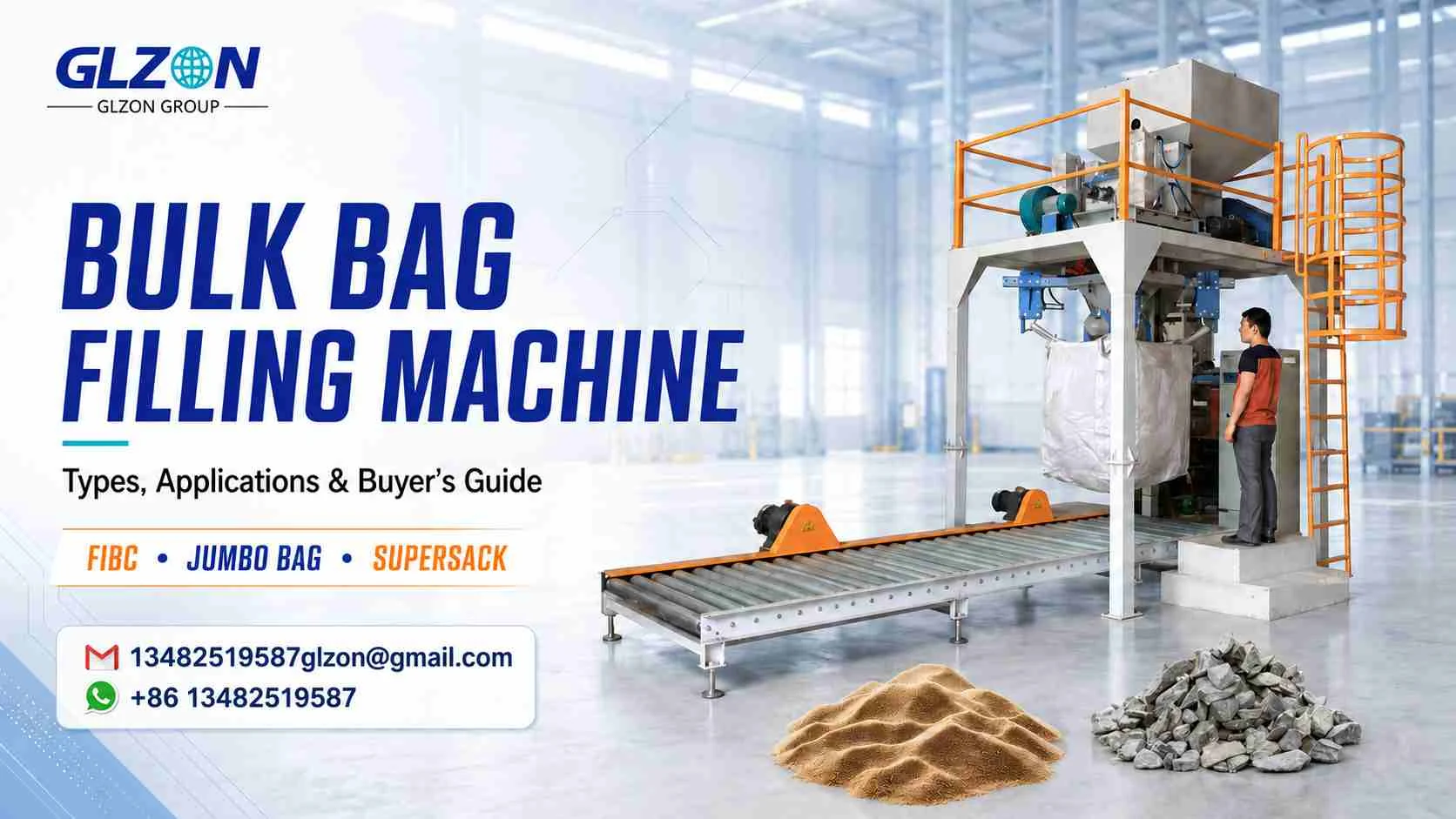
A bulk bag filling machine is an industrial system that loads measured quantities of powder, granules, pellets, grains, or other dry bulk materials into flexible intermediate bulk containers (FIBCs). The same equipment may also be called an FIBC bag filling machine, big bag filler, jumbo bag filling machine, supersack filler, or ton bag filler.
The correct machine is not selected by bag capacity alone. A reliable configuration must match the material’s flow behavior, bulk density, dust level, target bag weight, required production rate, bag design, available headroom, upstream supply, and downstream handling method. This guide explains those decisions so buyers can prepare a more accurate request for quotation and avoid paying for unsuitable equipment.
Quick answer: For free-flowing granules, gravity or belt feeding may be suitable. Fine or dusty powder may need an enclosed spout, dust extraction, and a controlled feeder. Material that bridges or compacts may require agitation, vibration, or a screw feeder. The final configuration should always be confirmed through a review of the actual material and bag specification.
What Is a Bulk Bag Filling Machine?
A bulk bag filling machine supports an empty FIBC, connects the bag inlet to a filling spout, transfers material from a hopper or production line, measures the loaded quantity, and releases the filled bag for removal. Depending on the application, the system may be a simple operator-assisted filling stand or a fully integrated line with automatic feeding, weighing, densification, conveyor discharge, dust collection, and production-data controls.
FIBCs are widely used because they allow large quantities of dry material to be handled as one unit. However, the bag must be positioned and supported correctly during filling. An uneven or unstable bag can be difficult to store, transport, or place on a pallet. The filling system therefore controls both material flow and bag presentation.
The following names often describe closely related equipment:
- Bulk bag filling machine: The most common general product name.
- FIBC bag filling machine: Emphasizes compatibility with flexible intermediate bulk containers.
- Big bag or jumbo bag filling machine: Common international names for the same general category.
- Supersack filler: A frequently used North American term.
- Ton bag filler: Often used when discussing high-capacity FIBCs, although actual bag weight depends on material density and bag design.
- Bulk bag filling station: Usually refers to a fixed filling area that may include a hopper, frame, controls, and discharge equipment.
These names should not be treated as proof that two machines have identical functions. Buyers should compare the actual mechanical configuration, control sequence, and included equipment.
How Does a Bulk Bag Filling Machine Work?
Although layouts vary, a typical filling cycle follows seven stages.
- Material supply: Product enters the filling system from a storage hopper, silo, mixer, crusher, process machine, or conveyor.
- Bag placement: The operator positions an empty FIBC beneath the filling head and attaches its lifting loops to the support hooks.
- Inlet connection: The bag’s filling spout is secured to the machine outlet. An inflatable seal or mechanical clamp may be used where a tighter connection is required.
- Bag preparation: Some systems inflate the empty bag before filling so it opens correctly and develops a more stable shape.
- Filling and weighing: A feeder controls product flow while the weighing system monitors the amount transferred. Coarse and fine-feed stages can help the machine approach the target weight more consistently.
- Settling or densification: Vibration or another compaction method may be used when the material traps air or needs help settling inside the bag.
- Release and discharge: The inlet connection and bag loops are released. The filled FIBC is removed by forklift, pallet truck, or conveyor, depending on the line design.
The exact cycle should be documented before purchase. A quotation that says only “automatic filling” may not clarify whether bag attachment, loop release, pallet placement, discharge, or liner handling remains manual.
Main Components of Bulk Bag Filling Equipment
Support frame
The frame carries the filling head and supports the FIBC during loading. Its height and loop-hook positions must suit the selected bag dimensions. A fixed frame can be economical for one bag format, while an adjustable bulk bag filling frame is more flexible when different bag heights are used.
Feeding hopper
The hopper provides a controlled buffer between the upstream process and the bag filler. Its geometry should match the material. A poorly selected hopper may encourage bridging, segregation, inconsistent flow, or material buildup.
Material feeder
The feeder controls how product reaches the bag. Common options include gravity gates, screw feeders, belt feeders, rotary valves, and vibrating feeders. The best choice depends on particle size, flowability, sensitivity, dust, and the required level of control.
Filling spout and bag clamp
The spout directs product into the FIBC. The bag connection should be easy to operate and suitable for the level of containment required. Dusty products generally benefit from a more enclosed connection and a dedicated dust-extraction path.
Bag-loop supports
Loop hooks hold the bag upright during filling. Their arrangement should match the FIBC design and provide safe operator access. Adjustable supports are useful when a plant uses more than one bag size.
Weighing system
Load cells and the control system measure the transferred quantity. Weighing performance depends on more than the load cells: feeder response, product flow, vibration, structural stability, control logic, and calibration all matter.
Control panel
The control system manages filling stages, target weight, feeder operation, alarms, and discharge. Advanced configurations may provide recipe storage, batch records, upstream and downstream interlocks, and communication with a plant control system.
Conveyor or pallet base
A roller conveyor can move the filled bag away from the filling point. Other systems fill directly onto a pallet or removable platform so a forklift can collect the load. The discharge method should be decided together with the factory layout.
Dust-control connection
An extraction port can capture displaced air and airborne dust near the filling point. Effective dust control depends on the entire system, including the bag connection, extraction airflow, ducting, filter selection, and maintenance procedures.
Selecting the Correct Feeding Method
Feeding technology has a major effect on filling control and material condition. The table below is a starting point, not a substitute for material testing.
| Feeding method | Often considered for | Important checks |
|---|---|---|
| Gravity gate | Free-flowing pellets, grains, crystals, and granules | Head pressure, cutoff response, particle damage, and available height |
| Screw feeder | Powders and materials needing controlled metering | Screw geometry, buildup, wear, heat, and product damage |
| Belt feeder | Granules, blends, and fragile materials | Belt cleaning, product leakage, cutoff accuracy, and available space |
| Vibrating feeder | Free-flowing or fragile products | Vibration transfer, flow stability, and dust generation |
| Rotary valve | Controlled discharge from hoppers or dust systems | Clearance, wear, shearing, leakage, and pressure conditions |
Send the supplier a representative material sample when possible. Videos, photographs, and a technical data sheet are helpful, but an actual filling or flow test can reveal aeration, bridging, segregation, and dust behavior that may not be obvious from a written description.
Types of Bulk Bag Filling Machines
Semi-automatic bulk bag filler
A semi-automatic system typically requires an operator to place the bag, attach its loops, connect the inlet, start the cycle, and release the filled bag. Material feeding and weighing may still be controlled automatically.
This configuration can be appropriate when production is intermittent, bag formats change frequently, or the plant wants a simpler system with lower integration complexity. The buyer should evaluate operator reach, access, lifting requirements, and cycle consistency rather than choosing only by purchase price.
Automatic big bag filling machine
An automatic big bag filling machine can coordinate more of the process, including staged feeding, weighing, bag inflation, densification, conveyor movement, and production records. Some operations, especially placing an empty FIBC and securing its loops, may remain manual unless robotic or specialized handling equipment is included.
Automation is most valuable when it removes a defined production constraint. Before ordering, calculate where time is actually being lost: material supply, bag attachment, filling, settling, loop release, pallet movement, or forklift availability.
Bulk bag filling station
A bulk bag filling station is usually a fixed installation connected to a production or storage process. It may combine a surge hopper, feeder, filling frame, control panel, dust extraction, weighing platform, and discharge conveyor.
This format suits plants that want the filler to operate as part of a continuous material-handling system. Interface details—such as signal exchange, emergency-stop zones, access platforms, and supporting steelwork—must be defined early.
Mobile bulk bag filler
A mobile or portable unit can serve multiple discharge points or seasonal operations. Mobility adds flexibility, but the plant must still provide safe positioning, stable support, power, dust extraction, and a consistent material connection at every location.
Gross-weigh and net-weigh systems
In a gross-weigh arrangement, the bag is weighed as material enters it. In a net-weigh system, material is measured in a separate weigh hopper before being released into the bag. Net weighing can separate the weighing and discharge stages, while gross weighing can provide a simpler material path. The correct approach depends on the process, product, target cycle, headroom, and cleaning requirements.
Materials and Industry Applications
Bulk bag filling equipment can be configured for many dry products, but “suitable for powder and granules” is too broad for final selection. Fine flour, abrasive mineral, plastic pellet, and irregular aggregate behave very differently.
| Industry | Example materials | Selection concerns |
| Agriculture | Rice, corn, wheat, seed, feed ingredients | Product damage, contamination control, cleanability |
| Food ingredients | Sugar, starch, flour, salt, dry mixes | Hygiene, contact materials, dust, cleaning method |
| Chemicals | Fertilizer, resin, additives, pigment | Compatibility, containment, corrosion, hazardous-area review |
| Plastics | Pellets, flakes, masterbatch, recycled granules | Segregation, static, fines, particle damage |
| Construction | Cement, mortar, sand, dry building mixtures | Dust, abrasion, bulk density, wear protection |
| Mining and minerals | Ore, stone, mineral powder, aggregate | Abrasion, impact, particle size, structural duty |
For every application, provide the supplier with the material name, particle-size range, loose and compacted bulk density, moisture level, operating temperature, dust behavior, flow characteristics, and any contamination restrictions.
Automatic vs. Semi-Automatic: Which Is Better?
Neither option is automatically better. The best system is the one that matches the operating pattern, labor plan, safety review, and investment target.
| Decision factor | Semi-automatic system | Automatic system |
| Operator involvement | Higher | Lower for included automated steps |
| Integration complexity | Usually lower | Usually higher |
| Changeover flexibility | Often straightforward | Depends on design and recipes |
| Production data | Basic or optional | More commonly integrated |
| Initial investment | Generally lower | Generally higher |
| Best fit | Intermittent or flexible filling | Repetitive or integrated production |
Do not compare two quotations until the scope is normalized. One supplier may include the hopper, feeder, weighing controls, conveyor, platform, and dust interface, while another may quote only the filling frame.
How to Choose a Bulk Bag Filling Machine
1. Define the material
Document how the product behaves, not just its commercial name. Is it free-flowing, cohesive, dusty, abrasive, fragile, aerated, corrosive, or sensitive to contamination? Does it bridge in a hopper or continue flowing after the feeder stops?
2. Confirm the FIBC specification
Provide bag height, width, filling-spout dimensions, discharge-spout design, loop length, liner details, coated or uncoated fabric, pallet requirement, and intended filled weight. If several bags are used, list every format.
3. Set a realistic capacity target
State the required filled bags per hour and explain how the target was calculated. Include time for attaching the bag, filling, settling, releasing, conveying, and removing the load. Upstream material supply must support the same rate.
4. Define weighing expectations
Ask how performance will be verified with your product and operating conditions. Clarify the target weight, acceptable tolerance, feeder stages, calibration method, test procedure, and treatment of in-flight material after the feeder closes.
5. Choose the discharge method
Decide whether the bag will leave on a pallet, roller conveyor, chain conveyor, or forklift platform. Confirm the filled load dimensions, pallet type, direction of travel, floor level, and transfer height.
6. Review dust and containment
Describe the product’s dust behavior and the plant’s exposure-control requirements. Ask how displaced air leaves the bag, where extraction connects, how filters are maintained, and what happens when the connection is released.
7. Check available space
Measure ceiling height, floor area, access routes, structural supports, maintenance clearance, and operator working zones. Include upstream and downstream equipment in the layout—not only the filler footprint.
8. Specify utilities and controls
Provide the plant’s electrical supply, control voltage, compressed-air conditions, communication requirements, and preferred component standards. Define signal exchange with existing equipment.
9. Plan cleaning and changeover
Explain how frequently products change and what level of cleaning is required. Check access to product-contact areas, residual-material points, tool requirements, and the procedure for preventing cross-contamination.
10. Evaluate service and documentation
Request the general arrangement drawing, electrical and pneumatic diagrams, operating manual, recommended spare-parts list, maintenance schedule, commissioning scope, training plan, warranty terms, and remote-support process.
Dust Control, Safety and Compliance
Dust control should be engineered for the actual material and site. Fine combustible dust, toxic powder, corrosive product, and ordinary nuisance dust require different assessments. The equipment supplier, plant owner, and qualified safety specialists should review applicable electrical classifications, ignition sources, grounding, extraction, guarding, access, emergency stops, and local regulations.
Important questions include:
- Is the material combustible, hazardous, irritating, or environmentally controlled?
- Can static electricity accumulate in the product, bag, or equipment?
- Which parts require guarding or interlocking?
- How will operators attach loops and bag spouts without unsafe reaching?
- What load will the floor and supporting structure carry?
- How will a partially filled or damaged bag be removed safely?
- What personal protective equipment and work procedures are required?
Do not treat the phrase “explosion-proof” as a complete specification. The required protection concept depends on the classified area, material hazards, equipment location, applicable standards, and the authority having jurisdiction.
Installation and Commissioning Checklist
Before delivery, confirm the machine layout and every interface. A practical commissioning plan should cover:
- Foundation and structural requirements
- Equipment lifting and access route
- Hopper and upstream connection
- Filled-bag removal path
- Electrical and compressed-air supply
- Dust-collection connection
- Control and emergency-stop interfaces
- Load-cell protection and calibration
- Test material and empty bags
- Operator and maintenance training
- Acceptance criteria and test records
Use the actual product during final testing whenever practical. A substitute material may flow, settle, or generate dust differently.
Maintenance for Reliable Filling
A preventive-maintenance program should be based on the machine manual, production hours, environment, and product characteristics. Typical checks include:
- Inspecting the filling spout, clamp, seals, and flexible connections
- Checking loop hooks and supporting components for wear or deformation
- Removing product buildup from the hopper and feeder
- Inspecting conveyor rollers, bearings, drive components, and guards
- Checking pneumatic hoses, valves, cylinders, and air preparation
- Protecting load cells from impact and verifying calibration
- Testing alarms, interlocks, and emergency stops
- Inspecting dust-extraction connections and filters
- Recording repeated faults and correcting their root causes
Never clean, adjust, or enter hazardous areas without following the plant’s isolation and lockout procedures.
Information to Send With Your RFQ
A detailed RFQ helps suppliers recommend comparable equipment. Send the following information:
| RFQ item | Information to provide |
| Material | Name, particle size, bulk density, moisture, temperature, flow and dust behavior |
| Bag | Dimensions, loop length, inlet size, liner, coating, pallet and target weight |
| Production | Required bags per hour, shifts per day, operating days and future expansion |
| Feeding | Existing hopper or silo, inlet height, available headroom and upstream rate |
| Discharge | Forklift, pallet, roller conveyor, chain conveyor or other method |
| Accuracy | Target weight, acceptable tolerance and verification method |
| Environment | Indoor or outdoor, temperature, humidity, corrosion and hazardous-area details |
| Utilities | Voltage, frequency, phase, control voltage and compressed air |
| Controls | Standalone operation, line interlocks, data recording and communication protocol |
| Documentation | Language, drawings, manuals, certificates and acceptance-test requirements |
Also provide photographs and a layout drawing with dimensions. If the project replaces an existing filler, explain what is working well and what problem must be solved.
Why Choose a Custom GLZON Filling Solution?
Bulk bag projects are most successful when the machine is configured around the material, bag, site, and handling process. GLZON can review the application and propose a filling arrangement that may include a feed hopper, material feeder, bag-support frame, weighing controls, dust-control connection, access platform, and conveyor discharge.
To request a recommendation, send GLZON:
- Material name and technical data
- Target weight per bag
- Empty FIBC dimensions and photographs
- Required bags per hour
- Available factory layout and ceiling height
- Preferred feeding and discharge arrangement
- Electrical supply and destination country
- Any dust, hygiene, corrosion, or hazardous-area requirements
The final proposal should state the equipment scope, excluded items, operating sequence, utility requirements, drawings, testing method, delivery documentation, and service responsibilities.
Frequently Asked Questions
What is the most common name for this equipment?
“Bulk bag filling machine” is a widely understood general name. FIBC bag filling machine, supersack filler, jumbo bag filler, big bag filling machine, and ton bag filler are also commonly used.
What does FIBC mean?
FIBC means flexible intermediate bulk container. It is a large flexible bag designed for handling dry bulk materials. Its construction, lifting loops, inlet, outlet, liner, and rated load should match the intended application.
Can one machine fill different bag sizes?
Yes, if the frame, filling head, loop supports, controls, and discharge arrangement are designed for the required range. Provide every bag drawing before the machine is finalized.
Which feeder is best for powder?
There is no universal answer. A screw feeder is often considered for controlled powder feeding, but the correct choice depends on flowability, aeration, buildup, abrasion, heat sensitivity, cleaning needs, and the required cutoff behavior.
Can a bulk bag filler handle grain and corn?
Yes, a suitable system can fill grains and other free-flowing agricultural materials. The design should minimize product damage, leakage, contamination, and segregation while meeting the required handling rate.
Is a one-ton bag always filled with exactly one ton?
No. “Ton bag” is a common product term, but the actual filled weight depends on bag rating, bag volume, material bulk density, transport limits, and process requirements.
What is the difference between a bulk bag filler and a bulk bag loader?
The terms sometimes overlap. A filler usually emphasizes controlled loading and weighing, while a loader may describe equipment that transfers material into the bag. Confirm whether weighing, bag support, controls, dust handling, and discharge equipment are included.
Can the machine connect to an existing production line?
Yes, but mechanical, electrical, control, safety, and capacity interfaces must be defined. Share drawings and operating information for the existing hopper, conveyor, silo, mixer, or process machine.
How is dust reduced during filling?
Dust may be reduced through an enclosed bag connection, controlled feeding, displaced-air management, extraction ducting, and suitable filtration. Performance depends on the full installation and the material—not one component alone.
What determines the price of bulk bag filling equipment?
Price is influenced by the frame and contact materials, feeder type, weighing system, automation, dust control, platform, conveyor, hazardous-area requirements, documentation, testing, and site services. Compare quotations using the same technical scope.
Final Buying Advice
The best bulk bag filling machine is not simply the model with the longest feature list. It is the system that handles the real material, fits the available plant space, supports the selected FIBC, meets the required operating cycle, controls dust appropriately, and integrates safely with upstream and downstream equipment.
Before choosing a supplier, prepare a complete material and bag specification, request a clearly defined operating sequence, compare quotation scope line by line, and agree on an acceptance test. This work at the purchasing stage reduces uncertainty during installation and helps the finished bulk bag filling system perform as intended.
Call to action: Send GLZON your material information, bag dimensions, target weight, required capacity, factory layout, and destination country to receive a customized bulk bag filling machine proposal.