
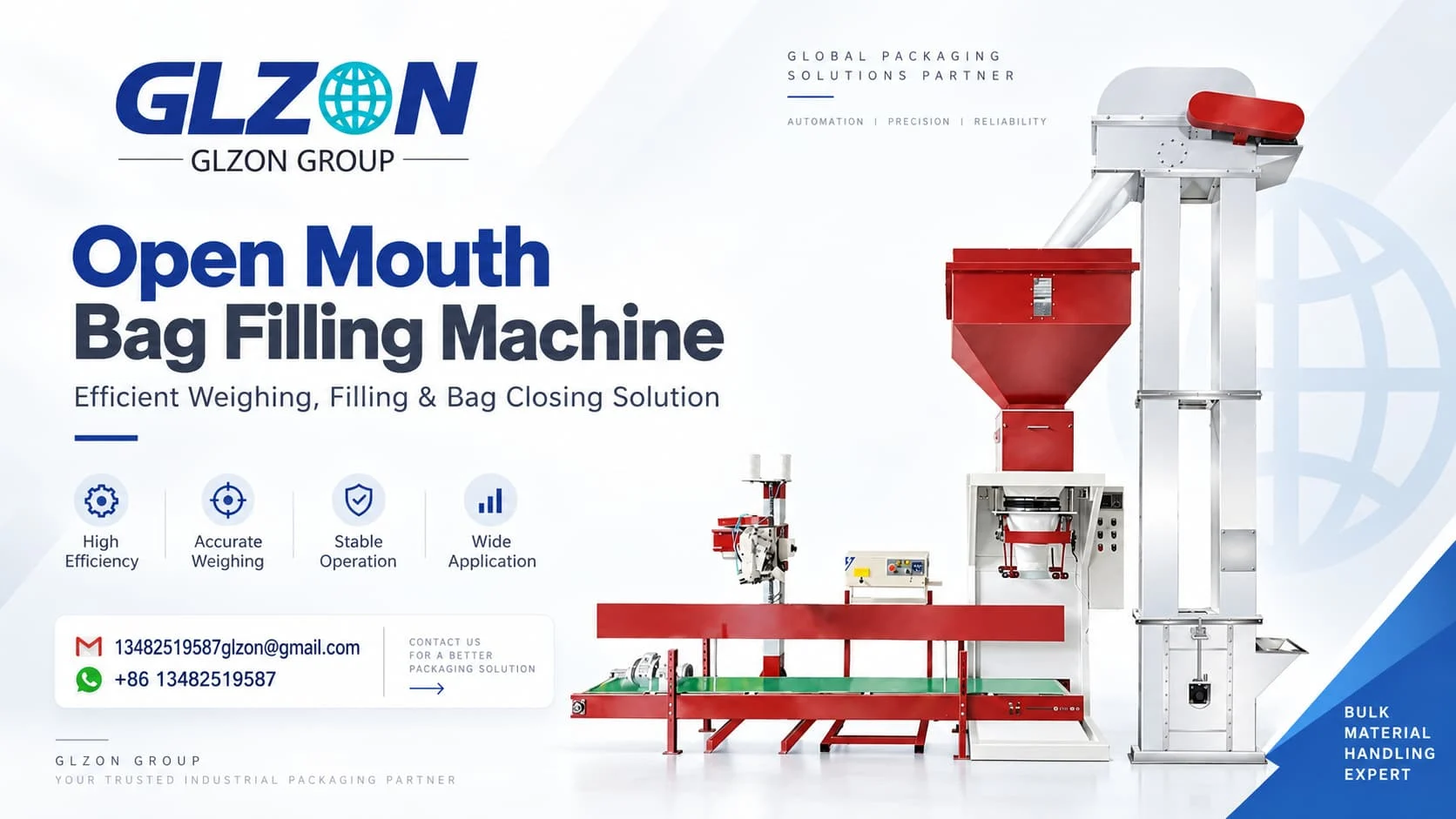
An open mouth bag filling machine weighs and fills powders, grains, granules, pellets, and other dry bulk materials into bags with an open top. Manufacturers commonly use these machines for 10 kg, 20 kg, 25 kg, 40 kg, and 50 kg bags.
Depending on the material, the machine may use gravity, belt, or screw feeding. In addition, a complete bagging line can include weighing, bag clamping, conveying, sewing, heat sealing, palletizing, and pallet wrapping.
However, bag weight alone does not determine the right machine. Product flow, bulk density, particle size, dust level, bag type, and required speed also affect the machine design.
Therefore, buyers should study both the material and the production process before choosing equipment.
This guide explains how an open mouth bag filling machine works, which materials it can pack, how the main feeding systems differ, and what information buyers should prepare before purchasing a bagging system.
What Is an Open Mouth Bag Filling Machine?
An open mouth bag filling machine measures a set amount of dry material and fills it into a bag with a fully open top.
First, an operator or automatic system places the empty bag below the filling outlet. Then, a bag clamp holds the bag in the correct position.
Next, the feeding system moves material toward the weighing unit. At the same time, load cells monitor the weight.
Once the machine reaches the target weight, the controller stops the product flow. Afterward, the clamp releases the filled bag onto a conveyor.
Finally, the conveyor moves the bag toward a sewing machine, heat sealer, or another closing system.
Manufacturers use open mouth bag filling equipment for many products, such as:
- Rice
- Wheat
- Corn
- Grain
- Seeds
- Animal feed
- Fertilizer granules
- Plastic pellets
- Flour
- Chemical powder
- Mineral powder
- Premixed materials
Although these products may use the same type of bag, they do not always need the same feeding system.
For example, rice flows more easily than fine flour. Therefore, the machine supplier should choose the feeder according to the actual product.
How Does an Open Mouth Bag Filling Machine Work?
A normal bagging process starts when material enters a storage or buffer hopper.
Next, a feeder moves the material toward the weighing system.
Depending on the product, the machine can use gravity feeding, belt feeding, screw feeding, or another suitable method.
At the same time, the weighing controller checks how much product enters the weighing section.
For better control, many machines use more than one feeding stage.
A common sequence is:
Fast feeding → slow feeding → final cutoff
At first, the machine fills most of the required weight quickly. Then, as the weight gets closer to the target, the system reduces the feeding speed.
As a result, the machine can reduce overfilling while keeping a practical production speed.
Once weighing is complete, the system fills the open bag and releases it onto the conveyor.
The main process is:
Material feeding → weighing → bag clamping → filling → bag release → conveying → sewing or sealing
In addition, larger production lines can include check weighing, printing, labeling, palletizing, and pallet wrapping.
What Materials Can an Open Mouth Bag Filling Machine Pack?
Open mouth bagging equipment can handle many dry bulk products. However, the best machine design depends on how the material flows.
Grain and Agricultural Products
Common applications include:
- Rice
- Wheat
- Corn
- Maize
- Barley
- Beans
- Seeds
- Animal feed
Because many of these materials flow freely, gravity or belt feeding can often provide a simple solution.
Granules and Pellets
The machine can also fill products such as:
- Fertilizer granules
- Plastic pellets
- Resin granules
- Feed pellets
- Chemical granules
- Mineral granules
In this case, the supplier may choose gravity or belt feeding based on the product.
Powders
Powder applications can include:
- Flour
- Mineral powder
- Chemical powder
- Fertilizer powder
- Premixed powder
- Industrial dry mixtures
Fine powders often need more flow control. Therefore, some powder applications require screw feeding, dust collection, or a more enclosed filling area.
Why Do Material Characteristics Matter?
Two products can use the same 25 kg bag weight but behave very differently.
For example, rice normally flows quickly through a hopper. Fine powder, however, may create dust or hold air during filling.
Likewise, wet or sticky materials may form blocks inside the hopper. Abrasive products can also cause faster wear on parts that touch the material.
Therefore, buyers should provide information about:
- Product name
- Bulk density
- Particle size
- Flow behavior
- Moisture
- Dust level
- Target bag weight
In addition, buyers should provide a product sample, photo, or video when possible.
As a result, the supplier can choose a more suitable feeding and weighing system.
Gravity Feeding for Free-Flowing Products
Gravity feeding uses the natural flow of the product to move material from the hopper toward the weighing section.
For this reason, it works well with many free-flowing materials, including rice, grain, seeds, plastic pellets, and some fertilizer granules.
Because the system has a relatively simple design, gravity feeding can provide fast and reliable filling.
However, it does not suit every material.
For instance, powder that sticks or forms blocks inside the hopper may require a screw feeder instead.
Belt Feeding for Granules
A belt feeder moves the product toward the weighing section at a controlled speed.
Therefore, it gives the system more control than basic gravity feeding.
Typical applications include grain, feed, pellets, fertilizer granules, and irregular particles.
In addition, belt feeding can provide gentler handling for products that may break during fast filling.
For this reason, the supplier should select the belt size and speed according to the product and required output.
Screw Feeding for Powders
Fine or difficult-flowing powders often need a screw feeder.
During operation, the rotating screw moves the material toward the weighing section at a controlled rate.
As a result, the machine can handle products that do not flow evenly under gravity.
Depending on the powder, the system may also need:
- Hopper mixing
- Dust collection
- Enclosed filling
- Anti-blocking devices
- Special filling spouts
Therefore, testing the powder can help the supplier choose the best setup.
25 kg Open Mouth Bag Filling Machine
A 25 kg open mouth bag filling machine is common in food, agriculture, fertilizer, chemical, and industrial packaging plants.
Typical products include rice, grain, feed, fertilizer, granules, flour, and industrial powder.
However, 25 kg of one material may need much more bag space than 25 kg of another.
For example, a dense mineral powder may need a relatively small bag. In contrast, a lightweight agricultural product may require a larger bag.
Therefore, buyers should provide both the target weight and the actual bag dimensions.
50 kg Open Mouth Bag Filling Machine
Manufacturers also use 50 kg open mouth bag filling machines for larger industrial packages.
Before choosing the equipment, buyers should confirm the material, bulk density, target weight, bag dimensions, bag material, bag opening size, required bags per hour, and closing method.
If production requires both 25 kg and 50 kg bags, the buyer should provide the complete weight range.
Then, the supplier can select the correct weighing unit, filling outlet, bag clamp, and conveyor.
As a result, one properly designed system may support several bag sizes within its approved operating range.
How Does the Weighing System Work?
Modern bag filling systems often use electronic load cells to measure the product.
During filling, the load cells send weight data to the controller. Next, the controller compares the actual weight with the preset target.
Instead of feeding at one speed for the whole cycle, the machine can use several feeding stages.
For example:
High-speed filling → fine filling → cutoff
At the beginning, high-speed feeding fills most of the bag quickly. After that, fine feeding reduces product flow as the machine gets closer to the target.
Finally, the controller stops the feeder at the set weight.
As a result, this method helps balance production speed and weight control.
However, actual performance also depends on:
- Product flow
- Bulk density
- Feeder type
- Target weight
- Feeding speed
- Machine setup
- Factory vibration
Therefore, buyers should review accuracy claims together with the test material and operating conditions.
For more technical information about automatic weighing systems, buyers can also review OIML R 61, which covers automatic gravimetric filling instruments.
Semi-Automatic Open Mouth Bag Filling Machine
A semi-automatic system usually requires an operator to place each empty bag onto the filling spout.
After placement, the machine handles:
- Bag clamping
- Weighing
- Feeding
- Filling
- Final cutoff
- Bag release
Next, a conveyor moves the filled bag toward the sewing or sealing equipment.
Therefore, a semi-automatic system can provide a practical balance between automation and investment.
For this reason, it works especially well for factories that want automatic weighing and filling but do not need automatic empty-bag feeding.
Fully Automatic Open Mouth Bagging Machine
A fully automatic system reduces manual bag handling.
Depending on the project, the line can include:
- Automatic bag picking
- Bag opening
- Bag positioning
- Automatic weighing
- Automatic filling
- Bag conveying
- Sewing or sealing
- Check weighing
- Palletizing
- Pallet wrapping
However, a higher automation level does not always mean a better investment.
Instead, buyers should match the system to production volume, available labor, factory space, and budget.
For example, automatic bag feeding can provide clear benefits for high-volume production. Meanwhile, a semi-automatic machine may be more practical for a smaller plant.
Bag Sewing or Heat Sealing?
The correct closing system depends mainly on the bag material.
Bag Sewing
For example, manufacturers often use industrial sewing machines for woven polypropylene bags and some paper bags.
After filling, the conveyor carries the bag through the sewing head. Then, the sewing system closes the top opening.
Heat Sealing
Plastic bags and suitable inner liners can use heat sealing.
In this case, the sealing unit applies controlled heat to close the opening.
Combined Closing
Some bags require both methods.
For instance, the line may first seal an inner plastic liner. Afterward, it can sew the outer woven or paper bag.
Therefore, buyers should provide bag samples, photos, or drawings before the supplier designs the closing section.
Open Mouth Bag Filling Machine vs Valve Bag Filling Machine
Open mouth bag machines and valve bag machines use different bag designs.
Open Mouth Bag Filling Machine
With an open mouth bag, the machine fills material through a large opening across the top.
Manufacturers commonly use this format for:
- Rice
- Grain
- Feed
- Fertilizer
- Pellets
- Granules
- Powders
After filling, a sewing or sealing system closes the bag.
Valve Bag Filling Machine
By comparison, a valve bag has a smaller filling opening, usually near one corner.
During operation, the machine introduces material through this valve.
For this reason, manufacturers often use valve bags for:
- Cement
- Dry mortar
- Gypsum
- Mineral powders
- Construction mixtures
Therefore, neither machine type is suitable for every application.
Instead, the correct choice depends on the material, bag style, dust level, required output, and closing process.
Powder Bagging vs Granule Bagging
Powders and granules often require different machine designs.
In general, free-flowing granules move easily through a hopper. Therefore, gravity or belt feeding may work well.
Powders, however, can behave differently.
For instance, fine powder may create dust, hold air, or form blocks inside the hopper.
As a result, a powder bagging machine may need:
- Screw feeding
- Dust collection
- Hopper mixing
- Enclosed filling
- Anti-blocking systems
Consequently, buyers should not choose equipment only because another factory fills the same bag weight.
What Does a Complete Open Mouth Bagging Line Include?
A complete packaging line can include several machines.
Material Feeding Equipment
First, the system must move material toward the filling machine.
Depending on the factory, this may involve:
- Belt conveyor
- Screw conveyor
- Bucket elevator
- Storage hopper
- Other feeding equipment
Weighing and Filling Machine
Next, the filling machine measures the required amount and fills the bag.
Bag Conveyor
After filling, a conveyor transfers the bag to the next machine.
Sewing or Sealing Machine
Then, the closing system secures the top of the bag.
Check Weigher
In addition, a check weigher can confirm the final package weight.
Printing or Labeling
If required, manufacturers can add batch codes, dates, or labels.
Palletizing System
Afterward, workers or robots can arrange the filled bags on pallets.
Pallet Wrapping
Finally, a stretch wrapper secures the finished pallet for storage and transport.
Therefore, companies planning a complete bagging line should consider all stages together.
How to Choose an Open Mouth Bag Filling Machine
Buyers can follow a simple process when selecting a machine.
1. Identify the Product
First, confirm whether the material is powder, granule, grain, pellet, or another dry product.
Also, check whether the product flows freely or needs controlled feeding.
2. Confirm the Target Weight
Next, define the required bag weight.
Common examples include:
- 10 kg
- 20 kg
- 25 kg
- 40 kg
- 50 kg
If several weights are required, provide the full range.
3. Measure the Bag
Then, provide the bag width, length, opening size, and material.
Actual bag samples can also help the supplier design the clamp and filling outlet.
4. Define Production Capacity
After that, specify the required number of bags per hour.
A clear capacity target helps the supplier choose a suitable feeder and weighing system.
5. Select the Closing Method
Next, choose sewing, heat sealing, or a combined closing process.
6. Decide the Automation Level
Finally, decide whether the line needs:
- Manual bag placement
- Automatic bag feeding
- Automatic sewing
- Automatic palletizing
- Automatic wrapping
By following these steps, the supplier can recommend a machine that better matches the actual production process.
What Information Should You Send for a Quotation?
A detailed inquiry helps the supplier recommend the right machine.
First, provide the material name and explain whether the product is powder, grain, granule, or pellet.
Next, state the target weight, such as 25 kg or 50 kg.
In addition, provide the bag dimensions, bag material, and opening size.
Then, state the required production capacity in bags per hour.
After that, confirm whether the bag needs sewing, heat sealing, or another closing method.
Finally, explain whether you need only the filler or a complete system with conveyors, sewing, palletizing, and wrapping.
With this information, the supplier can choose the feeder, weighing system, bag clamp, and downstream equipment more accurately.
Why Does Product Testing Matter?
Material testing can reduce uncertainty before machine production.
For example, one powder may flow easily, while another may stick inside the hopper.
Likewise, one type of granule may move quickly through the feeder, while another may break during handling.
Therefore, testing helps the supplier evaluate:
- Material flow
- Feeding method
- Dust level
- Weighing stability
- Bag filling condition
- Required machine options
As a result, product testing becomes especially useful for unusual or difficult materials.
Open Mouth Bag Filling Machine Manufacturer
GLZON supplies industrial bag filling and packaging equipment for powders, grains, granules, and other dry bulk materials.
Rather than using one machine design for every application, GLZON selects the system according to the material, bag weight, bag dimensions, production output, factory layout, closing method, and automation needs.
In addition, a complete line can combine material feeding, weighing, bag filling, conveying, sewing or sealing, palletizing, and pallet wrapping.
As a result, manufacturers can build a bagging line around their real production process instead of changing production to suit a standard machine.
Request an Open Mouth Bag Filling Solution
Looking for an open mouth bag filling machine for your production line?
To receive a suitable recommendation, send us:
- Material name
- Powder, grain, granule, or pellet
- Target bag weight
- Bag dimensions
- Required bags per hour
- Bag closing method
- Required automation level
With these details, GLZON can evaluate the suitable feeding, weighing, and bag-handling setup for your application.