
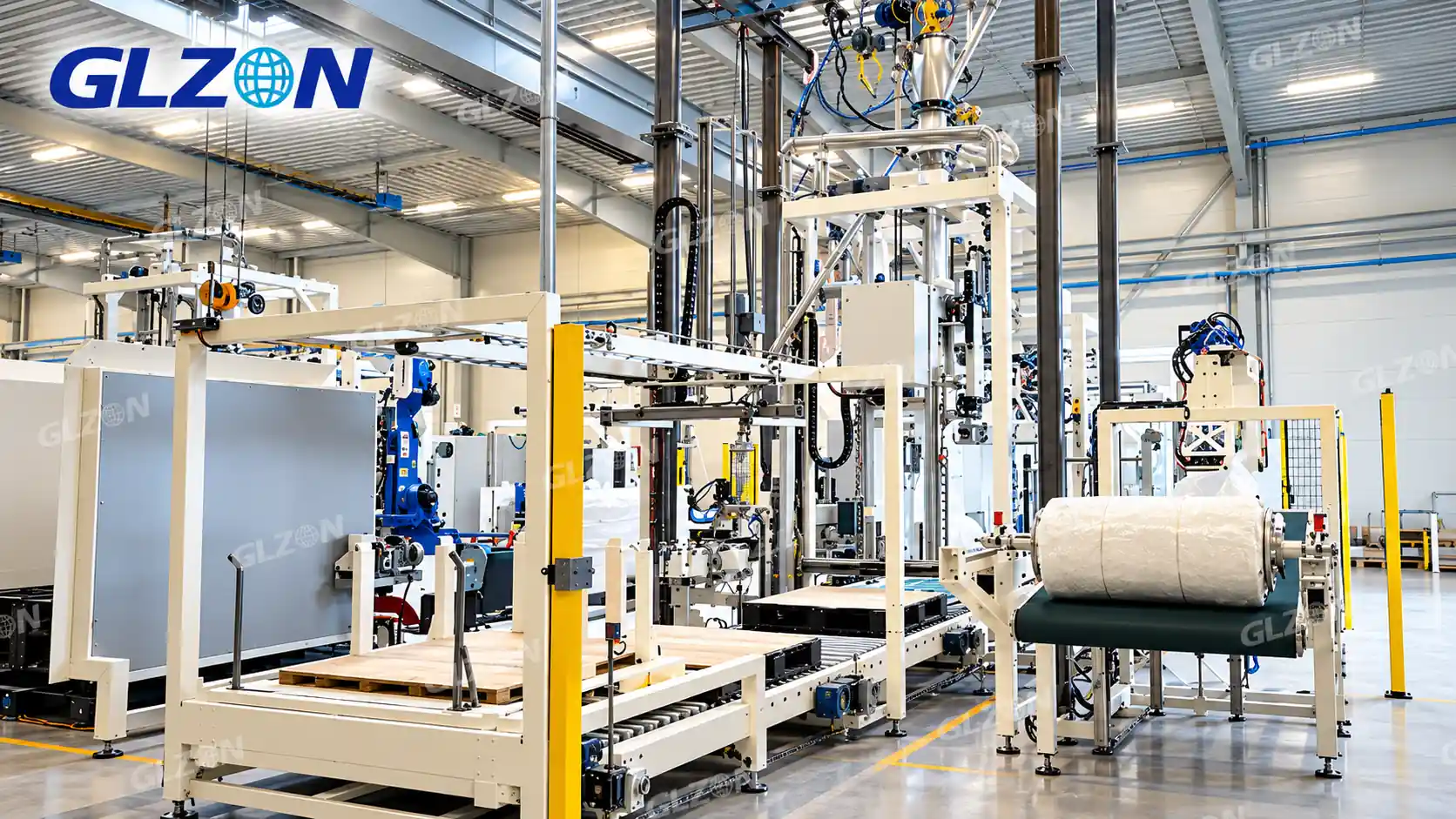
Big Bag Filling Machine for Powder, Granules and FIBC Bulk Bags
A big bag filling machine helps manufacturers package powders, granules and pellets into flexible intermediate bulk containers (FIBCs). It combines material feeding, weighing and bulk bag handling to support efficient industrial packaging operations.
This equipment suits companies in agriculture, building materials, minerals, plastics and other dry bulk processing industries. In addition, suitable filling and dust-control arrangements help manufacturers manage product flow and reduce unnecessary material loss.
GLZON provides industrial filling and packaging equipment, including bulk bag filling solutions. Therefore, customers can discuss configurations based on their materials, bag dimensions, target weights and production requirements.
Big Bag Filling Machine Overview
A big bag filling machine transfers dry bulk materials into large industrial bags through a controlled filling system.
Manufacturers commonly use FIBCs, also called jumbo bags, bulk bags or ton bags, to store and transport large quantities of dry material.
First, the filling station supports and positions a compatible bag. Next, the feeding system delivers material through the filling outlet. Meanwhile, the weighing system monitors the filling quantity.
As a result, manufacturers can maintain consistent packaging quantities while reducing unnecessary manual material handling.
Furthermore, a suitable system can incorporate dust extraction, bag settling and conveyor handling. The exact features depend on the machine configuration.
Key Features of an Automatic Big Bag Filling Machine
1. Quantitative Weighing System
A weighing system controls the amount of material entering each bulk bag.
Manufacturers can select suitable filling targets according to their packaging requirements. In addition, controlled weighing helps reduce inconsistent bag weights.
Some industrial systems offer gross weighing or net weighing configurations.
Gross weighing measures the material while the bag remains on the weighing system. In contrast, net weighing measures a batch before the system transfers it into the bag.
However, buyers should confirm which weighing technology GLZON offers for their selected model.
2. Automatic Material Feeding
A material feeding system transfers bulk products toward the filling station.
Different materials require different feeding arrangements. For example, free-flowing granules may behave differently from fine powders.
Therefore, manufacturers should review bulk density, particle size, moisture content and flow characteristics.
A suitable feeding arrangement can help maintain consistent material delivery during repeated filling cycles.
3. Flexible FIBC Bag Handling
Industrial manufacturers use different FIBC designs, including bags with various lifting-loop arrangements and filling spouts.
Automated filling systems may support different bag-handling configurations.
For example, advanced systems can incorporate automatic bag positioning or robotic handling.
However, these functions depend on the equipment design. GLZON must confirm whether manual, semi-automatic or robotic bag handling is available for the proposed configuration.
4. Dust-Controlled Filling Arrangement
Fine powders can release dust during material transfer.
A suitable bulk bag filling system may incorporate dust extraction or a sealed filling connection to help control dust at the filling point.
In addition, proper equipment selection can improve material containment during packaging.
However, dust-control performance depends on the product and equipment configuration.
Manufacturers should therefore confirm the required extraction system and workplace conditions before purchasing.
5. Bag Vibration and Product Settling
Some bulk materials settle unevenly during filling.
A bag-settling system can help distribute suitable products more evenly inside the FIBC.
For example, certain automated filling systems use vibration to encourage product settling.
As a result, manufacturers may achieve a more consistent bag shape.
Nevertheless, vibration is not suitable for every material. The appropriate settling method depends on product characteristics.
6. Filling Spout and Bag Connection
The filling spout connects the material discharge system to the bag opening.
A suitable connection helps guide material into the FIBC during packaging.
Some advanced filling systems also offer adjustable filling connections for different bag dimensions.
However, spout adjustment, sealing arrangements and bag compatibility require confirmation for the actual GLZON machine.
7. PLC and HMI Control Options
Automated packaging equipment may use PLC controls and a human-machine interface (HMI) to manage filling operations.
Depending on the configuration, operators can use the interface to adjust filling targets and monitor the production process.
In addition, certain systems support different filling programs.
However, customers should confirm the available controls, recipes and monitoring functions before ordering.
8. Conveyor and Pallet Handling Integration
A big bag filling system can form part of a larger industrial packaging line.
For example, manufacturers may connect compatible conveyors and pallet-handling equipment to the filling station.
As a result, finished bags can move toward the next handling stage with less manual transfer.
However, automatic pallet feeding, pallet stacking and robotic handling are separate capabilities that require specific equipment.
Technical Specifications of the Big Bag Filling Equipment
| Technical Parameter | Configuration Details |
|---|---|
| Equipment type | Big bag / FIBC filling machine |
| Suitable materials | Compatible powders, granules and pellets |
| Packaging type | FIBC, jumbo bags and bulk bags |
| 충전 방법 | Quantitative filling |
| Weighing system | Model-dependent |
| Bag positioning | Manual or automated options to be confirmed |
| Dust-control system | Configuration-dependent |
| Bag settling | Optional system to be confirmed |
| Control system | Depends on selected model |
| Conveyor integration | Project-dependent |
| Pallet handling | Optional integration to be confirmed |
| Filling weight range | Requires GLZON confirmation |
| Weighing accuracy | Requires GLZON confirmation |
| Packaging speed | Requires GLZON confirmation |
| Electrical requirements | Requires GLZON confirmation |
| Machine dimensions | Requires GLZON confirmation |
The table identifies features and parameters that buyers should discuss when selecting a bulk bag filling machine. It does not represent a confirmed specification for one GLZON model.
Industrial Applications of the Big Bag Filling Machine
A big bag filling machine can support different industries that package dry bulk materials.
Agricultural Granule Packaging
Agricultural manufacturers handle different dry granular products.
For example, suitable fertilizer granules and other agricultural materials may require large industrial bags.
A quantitative filling system helps control packaging quantities. In addition, compatible bag-handling equipment can support repeated production cycles.
However, manufacturers should review material moisture and flow properties before selecting equipment.
Plastic Pellet Packaging
Plastic manufacturers frequently transport polymer pellets in industrial bulk packaging.
A suitable jumbo bag filling system can help manage measured pellet packaging.
Furthermore, controlled feeding can support consistent filling operations.
The final equipment arrangement should match pellet size, bulk density and required output.
Building Material Packaging
Building material manufacturers handle many dry powders and granular products.
For example, suitable mineral powders and dry construction materials may require large-capacity bags.
A weighing-based filling system can support consistent packaging quantities.
However, abrasive materials may require special consideration of equipment wear and component selection.
Mineral and Mining Material Packaging
Mineral processing facilities also use bulk bags for suitable dry products.
A properly selected filling machine can support measured packaging of compatible mineral granules and powders.
In addition, conveyor integration can help organize finished-bag handling.
Nevertheless, material characteristics and packaging requirements must guide the equipment selection.
Animal Feed and Agricultural Processing
Manufacturers of compatible dry feed materials may also evaluate FIBC filling systems.
For example, pellet products may require controlled feeding and bulk packaging.
However, equipment intended for feed-contact applications must meet the relevant material and hygiene requirements.
Therefore, buyers should verify suitable construction and cleaning arrangements before ordering.
How Does a Big Bag Filling Machine Work?
A typical big bag filling process includes several coordinated stages.
Step 1: Empty Bag Preparation
First, the operator or an appropriate handling system positions the empty FIBC at the filling station.
Step 2: Filling Spout Connection
Next, the filling arrangement connects the bag opening to the material discharge outlet.
Step 3: Filling Target Selection
The operator selects the required filling quantity through the available control system.
Step 4: Material Feeding
The feeding system transfers the dry material toward the bag.
Meanwhile, the quantitative measurement system monitors the filling process according to its configuration.
Step 5: Filling Completion
The filling system stops material discharge when it reaches the configured target.
Step 6: Bag Finishing
The operator or suitable automated equipment prepares the filled bag for the next handling stage.
The available finishing functions depend on the machine.
Step 7: Finished Bag Transfer
Finally, an appropriate handling system transfers the filled bag away from the filling station.
The actual operating sequence varies according to the machine’s automation level and production-line design.
Benefits of Industrial FIBC Filling Equipment
Consistent Packaging Quantities
Quantitative filling helps manufacturers control the amount of product in each bulk bag.
As a result, packaging operations can become more consistent.
Reduced Manual Material Handling
Suitable automated functions reduce repetitive handling during the packaging process.
In addition, conveyor integration can simplify finished-bag movement.
Better Production Workflow
A coordinated filling station combines material feeding and quantitative measurement.
Therefore, manufacturers can organize bulk material packaging more efficiently.
Dust Management
Suitable dust-control equipment can help reduce material escape during filling.
However, manufacturers must select the correct system for their products and working environment.
Flexible Equipment Configurations
Industrial FIBC filling systems can support different levels of automation.
For example, manufacturers may compare operator-assisted equipment with more automated filling arrangements.
Consequently, they can select a solution that matches their production needs.
Semi-Automatic vs. Fully Automatic Big Bag Filling Machines
Manufacturers can choose different automation levels for their bulk bag filling operations.
Semi-Automatic Big Bag Filling Machine
A semi-automatic filling system generally requires operators to assist with bag positioning or other handling tasks.
Meanwhile, the machine controls selected filling functions.
This arrangement may suit facilities with flexible packaging requirements or lower production volumes.
Fully Automatic Big Bag Filling Machine
A fully automatic system can coordinate additional functions through integrated controls and handling equipment.
For example, advanced systems may include automatic bag positioning and downstream bag transfer.
However, the exact functions depend on the proposed machine.
Therefore, buyers should confirm which processes the equipment performs automatically.
Which Configuration Should You Choose?
The best option depends on material characteristics, target production capacity and available factory space.
In addition, buyers should consider bag design, required weighing accuracy and preferred container handling.
GLZON can discuss equipment arrangements based on these project requirements.
How to Choose the Right Big Bag Filling Machine
Choosing suitable FIBC filling equipment begins with understanding the material.
First, identify whether the product is a powder, granule or pellet.
Next, determine its bulk density, flow properties and moisture characteristics.
These factors can affect feeding and weighing performance.
Furthermore, buyers should confirm the required filling weight and bag dimensions.
The FIBC design also matters. For example, different lifting-loop arrangements and filling spouts may require different handling equipment.
In addition, establish the desired number of filled bags per hour.
Manufacturers should also review dust-control needs, installation space and electrical requirements.
Finally, confirm whether the project requires conveyor integration, pallet handling or additional automated features.
For general information about industrial bulk bags, the Flexible Intermediate Bulk Container Association provides useful FIBC resources.
By providing these details, customers can help GLZON evaluate suitable filling equipment.
Why Choose GLZON for Big Bag Filling Equipment?
GLZON focuses on industrial filling, weighing and packaging equipment for manufacturing applications.
Different dry bulk materials require different feeding and filling arrangements.
For example, a free-flowing plastic pellet may behave differently from a fine mineral powder.
Therefore, equipment selection should consider the material properties, bag design and expected output.
Our team can discuss bulk bag filling solutions according to your production requirements.
In addition, customers can request information about suitable weighing systems, filling arrangements and equipment integration.
Whether you need an independent FIBC filling station or a larger bulk material packaging line, contact GLZON to discuss available solutions.
자주 묻는 질문
What is a big bag filling machine?
A big bag filling machine fills dry bulk materials into flexible intermediate bulk containers, also called FIBCs, jumbo bags or bulk bags.
What materials can a big bag filling machine handle?
Suitable systems can package powders, granules and pellets. However, actual compatibility depends on the material and machine configuration.
Can the machine fill 1000kg jumbo bags?
Some industrial big bag filling systems support 1000kg packaging. However, GLZON must confirm the filling range and rated capacity of the proposed model.
What is the difference between gross and net weighing?
Gross weighing measures material while it fills the bag on the weighing system. In contrast, net weighing measures a batch before transferring it into the bag.
Can the machine handle different FIBC sizes?
Some systems support different bag dimensions. However, the actual compatible sizes and lifting-loop configurations depend on the equipment.
Does the machine include automatic bag placement?
Certain advanced FIBC filling systems offer automated bag handling. Nevertheless, GLZON must confirm whether this option is available for the selected model.
Does the equipment include dust control?
Suitable systems may include dust extraction or enclosed filling connections. However, the actual dust-control arrangement depends on the selected configuration.
What is the filling accuracy?
The required filling accuracy depends on the weighing system and material characteristics. Therefore, customers should request verified performance specifications for the proposed machine.
How many bulk bags can the machine fill per hour?
Production capacity depends on material flow, bag size, filling weight and automation level. GLZON should confirm the expected output for the specific project.
Can the machine connect with a conveyor?
A suitable big bag filling system may support conveyor integration. However, the conveyor arrangement and load requirements need project-specific evaluation.
Is a fully automatic big bag filling system available?
Fully automatic FIBC filling systems exist in the market. Customers can discuss GLZON’s available configurations and automation capabilities before requesting a quotation.
Can GLZON provide a customized quotation?
Customers can contact GLZON with their material characteristics, FIBC dimensions, required filling weight and production targets.
Request a GLZON Big Bag Filling Machine Quotation
Are you looking for a big bag filling machine for powder, granule or pellet packaging?
GLZON can discuss your production requirements and help you evaluate suitable industrial FIBC filling equipment.
For a customized quotation, please provide:
- Material name and characteristics
- Required filling weight per bag
- FIBC dimensions and lifting-loop design
- Desired bags-per-hour production
- 선호하는 자동화 수준
- Dust-control and conveyor requirements
- Destination country and receiving port
Contact GLZON today to request technical information, machine pricing and a customized bulk bag filling solution.