
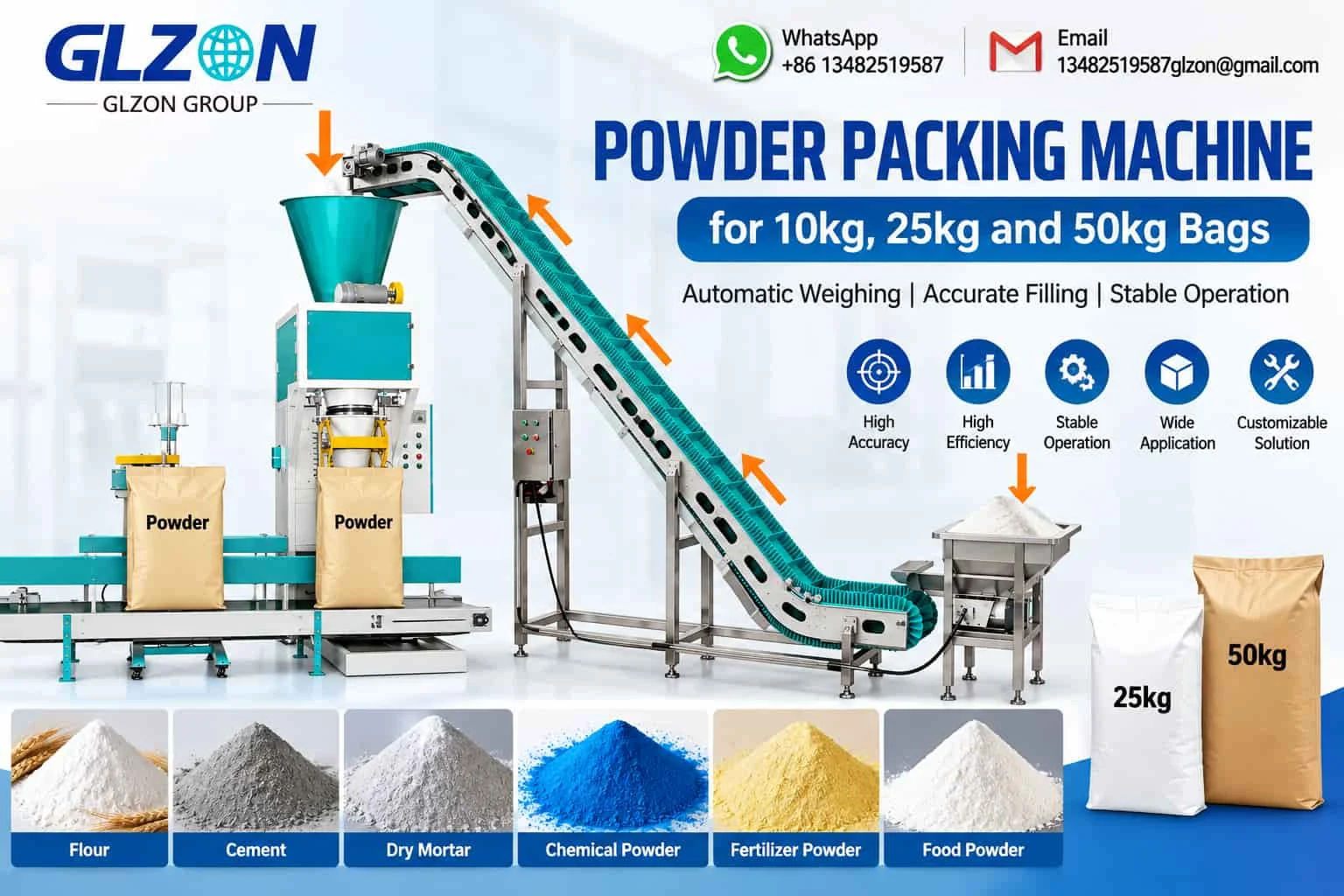
A powder packing machine accurately weighs, fills, and packs powder materials into bags for industrial production. Manufacturers use this equipment for flour, fertilizer, chemical powder, dry mortar, cement, mineral powder, and many other products. Moreover, automatic weighing helps improve filling consistency, reduce material waste, and decrease manual handling.
Depending on the powder characteristics, the machine can use screw feeding, auger dosing, gravity feeding, or vibrating feeding. Therefore, choosing the correct feeding system is important for stable operation, filling accuracy, and production efficiency.
We can configure the machine according to the powder type, bulk density, bag weight, required capacity, dust level, bag material, and closing method.
What Is a Powder Packing Machine?
A powder packing machine is industrial packaging equipment that measures and fills powder products into pre-made bags.
A typical system includes:
- 材料ホッパー
- Feeding system
- 計量システム
- 注ぎ口
- Pneumatic bag clamp
- PLC control
- HMI touchscreen
- Bag conveyor
- Optional sewing or sealing machine
First, the feeding system transfers powder from the hopper to the weighing unit. Next, the weighing system measures the required quantity. The machine then fills the product into the bag and stops automatically when it reaches the target weight.
As a result, manufacturers can achieve more consistent packaging than with manual weighing and filling.
How Does a Powder Packing Machine Work?
A typical packing process follows these steps:
Powder Feeding → Weighing → Bag Clamping → Filling → Final Weight Control → Bag Release → Conveying → Sewing or Sealing
1. Powder Feeding
The production system transfers powder into the packing machine from a hopper, silo, vacuum feeder, or screw conveyor.
For fine powders, screw and auger feeders provide controlled material flow. In contrast, powders with better flowability may work with gravity feeding.
2. Automatic Weighing
The operator enters the required filling weight on the HMI.
Load cells continuously measure the material. Meanwhile, the control system adjusts the feeding process according to the programmed target.
3. Bag Clamping
The operator places an empty bag under the filling outlet. A pneumatic clamp then holds the bag securely during filling.
For a fully automatic production line, an automatic bag-feeding system can also handle this process.
4. Fast and Slow Filling
The machine can use two-stage filling.
First, fast feeding quickly fills most of the required quantity. Then, the control system switches to slow feeding as the weight approaches the target.
Consequently, this method combines higher production speed with better filling control.
5. Bag Release
After the bag reaches the required weight, the machine stops feeding and releases it onto the conveyor.
6. Bag Closing
Finally, the conveyor transfers the bag to a sewing or sealing system.
Depending on the packaging material, customers can choose:
- Bag sewing
- Heat sealing
- Folding and sewing
- Manual closing
Materials Suitable for a Powder Packing Machine
Different powders have different flow properties, densities, particle sizes, and dust levels. Therefore, the machine configuration should match the actual product.
Chemical Powder
A powder bagging system can handle many industrial chemical products, including:
- Chemical additives
- Detergent powder
- Pigment powder
- Resin powder
- Industrial additives
- Fine chemical materials
For corrosive products, stainless steel contact parts may provide better compatibility.
Fertilizer Powder
A powder packing machine can also handle:
- Organic fertilizer powder
- Compound fertilizer
- Agricultural additives
- Soil amendment powder
- Powdered nutrients
Because some fertilizer products can affect carbon steel, customers should provide detailed material information before production.
Dry Mortar
A dry mortar packing machine can pack:
- 乾式モルタル
- Tile adhesive
- Wall putty
- Cement-based mixtures
- Gypsum powder
- Construction premixes
These materials often create dust. Therefore, adding a dust extraction connection can improve the production environment.
Cement Powder
Cement is both dusty and abrasive. For this reason, a cement powder packing system requires suitable feeding components, reliable weighing equipment, and effective dust management.
Food Powder
The machine can also handle suitable food powders, such as:
- Flour
- Cocoa powder
- Starch
- Sugar powder
- Milk powder
- Spice powder
- Food ingredients
For food applications, stainless steel product-contact parts can make cleaning easier.
Mineral Powder
Industrial mineral applications include:
- Calcium carbonate
- Limestone powder
- Talc
- Fine stone powder
- Mineral additives
The correct feeding method depends on particle size, flowability, and bulk density.
Powder Packing Machine for 10kg, 25kg and 50kg Bags
Industrial powder packaging systems can support different bag weights.
Common options include:
- 5 kg
- 10 kg
- 20 kg
- 25 kg
- 40 kg
- 50 kg
A 25kg powder packing machine is suitable for many fertilizer, chemical, food, and construction material applications.
Meanwhile, a 50kg powder bagging machine can handle larger industrial bags when the material and production process allow it.
The final filling range depends on the weighing system, feeding method, bag dimensions, material density, and required production capacity.
Main Components of a Powder Packing Machine
Feeding Hopper
The hopper stores material before filling.
We can adjust its size according to:
- Production capacity
- Powder density
- 工場のレイアウト
- Upstream feeding system
Screw or Auger Feeder
The feeder controls powder movement from the hopper toward the filling point.
Screw feeding works particularly well for:
- Fine powder
- Dusty powder
- Low-flow materials
- Products requiring controlled dosing
Moreover, the system can adjust feeding speed during different stages of the filling cycle.
Load-Cell Weighing System
Load cells measure the amount of material during the filling process.
Filling performance depends on several factors, including:
- Product flowability
- かさ密度
- Target weight
- Feeding speed
- Machine configuration
- Production environment
Pneumatic Bag Clamp
A pneumatic clamp holds the open bag around the filling spout.
A secure bag connection also helps control powder leakage around the bag opening.
Dust Collection Connection
Fine powder can create airborne dust during filling. Therefore, we can add a dust extraction connection for suitable applications.
The customer can then connect the machine to an external dust collection system.
PLC and HMI Control
The PLC manages machine operation, while the HMI gives the operator a simple interface for setting production parameters.
Operators can adjust:
- Target filling weight
- Fast-feed value
- Slow-feed value
- Feeding speed
- Filling timing
- Bag clamp timing
In addition, suitable control systems can store recipes for different products or filling weights.
Bag Conveyor
After filling, the conveyor moves the bag toward the closing system.
The production line can also connect to a checkweigher, sewing machine, sealing machine, or other downstream equipment.
Powder Packing Machine Specifications
| Item | Typical Configuration |
|---|---|
| Machine Type | Powder Packing Machine |
| 素材 | Powder |
| Filling Range | 10–50 kg or customized |
| Feeding Method | Screw, auger, gravity or vibrating |
| Weighing | Load-cell weighing |
| 制御 | PLC + HMI |
| Bag Clamping | Pneumatic |
| Dust Collection Connection | Optional |
| Conveyor | Optional |
| Bag Closing | Sewing or heat sealing |
| Contact Material | Carbon steel or stainless steel |
| Automation | Semi-automatic or automatic |
| Voltage | Customized |
Note: Final specifications depend on the actual powder, bag size, required output, and production conditions.
Feeding Methods for a Powder Packing Machine
Selecting the correct feeder directly affects production performance.
Screw Feeding
Screw feeding provides controlled material movement and is suitable for many powders.
Typical applications include:
- Flour
- 化学粉末
- Fertilizer powder
- 乾式モルタル
- ミネラルパウダー
Furthermore, the control system can adjust screw speed to support fast and slow filling.
Auger Feeding
Auger feeding works well for many fine and medium-density products.
It provides controlled dosing and can improve filling stability for powders that do not flow freely.
Gravity Feeding
Gravity feeding uses the natural flow of the product.
This method can work for powders with very good flowability. However, sticky or poorly flowing materials may require another solution.
Vibrating Feeding
A vibrating feeder can provide gentle and controlled product movement for certain materials.
Therefore, it may suit applications where the powder or fine granules require more controlled feeding.
Semi-Automatic vs Automatic Powder Packing Machine
| 特集 | Semi-Automatic | Automatic |
|---|---|---|
| Bag Placement | Manual | Automatic or assisted |
| Weighing | Automatic | Automatic |
| Filling | Automatic | Automatic |
| Bag Release | Automatic | Automatic |
| 閉会 | Optional | Integrated option |
| Labor Requirement | Medium | 下へ |
| Production Output | Medium | より高い |
| Initial Investment | 下へ | より高い |
| Line Integration | Available | More extensive |
A semi-automatic machine often suits factories with moderate output requirements.
On the other hand, automatic powder packing equipment can reduce manual handling and integrate more easily with continuous production lines.
Powder Packing Machine for Dry Mortar
Dry mortar plants often require durable and dust-conscious packaging equipment.
A typical production line can include:
Storage Silo → Screw Feeder → Powder Packing Machine → Conveyor → Bag Closing System
Depending on the project, customers can also add:
- Dust collector
- チェックウェイヤー
- Bag flattening conveyor
- Palletizer
- Stretch wrapper
Because dry mortar can produce significant dust, the production line should include an appropriate dust-management strategy.
Powder Packing Machine for Fertilizer
Powder fertilizer requires controlled feeding and reliable weighing.
Suitable applications may include:
- Organic fertilizer
- Compound fertilizer
- Agricultural powder
- Soil additives
In addition, stainless steel contact parts can be selected when the product requires better corrosion resistance.
Powder Packing Machine for Food Powders
Food powder packaging requires additional attention to product-contact materials and cleaning.
For suitable applications, stainless steel components can provide a cleaner contact surface.
Products may include:
- Flour
- Cocoa
- Starch
- Sugar powder
- Milk powder
- Food additives
However, customers should provide full material and hygiene requirements before machine design.
Advantages of an Automatic Powder Packing Machine
Consistent Filling
Controlled feeding and weighing help maintain more consistent bag weights.
Higher Efficiency
Automatic weighing and filling reduce the time required for manual measurement.
Reduced Manual Handling
Operators spend less time weighing products by hand.
Lower Product Waste
Controlled dosing can reduce unnecessary overfilling.
Flexible Configuration
We can configure the machine for different powders, bag weights, feeding systems, and production requirements.
Dust-Control Options
For dusty products, we can add a connection for an external dust collection system.
Easy Control
The PLC and HMI allow operators to adjust filling parameters from one control interface.
Production Line Integration
The machine can work with:
- Screw conveyors
- Vacuum feeders
- Bag conveyors
- Sewing machines
- Heat sealers
- Checkweighers
- Palletizers
- Stretch wrappers
Bag Types for Powder Packing
The machine can work with different pre-made bags depending on the application.
Examples include:
- PP woven bags
- Kraft paper bags
- PE bags
- Laminated bags
- Open mouth bags
For free-flowing granular materials rather than powders, you can also consider an open mouth bag filling machine as a dedicated solution.
Internal link: Link “open mouth bag filling machine” to your related product page.
Bag Sewing and Sealing Options
Sewing System
Bag sewing works well for many woven and paper bags.
Applications include:
- Fertilizer bags
- Feed bags
- Industrial powder bags
- Paper bags
Heat Sealing
Heat sealing can close suitable PE and laminated packaging materials.
However, the bag structure must match the sealing technology.
Folding and Sewing
Some production lines fold the top of the bag before sewing.
As a result, the finished package can achieve a cleaner closure.
How to Choose a Powder Packing Machine
Before selecting equipment, provide the following information.
1. Product Name
Tell us exactly what powder you need to pack.
For example:
- Flour
- セメント
- 肥料
- 化学粉末
- 乾式モルタル
2. Bulk Density
Bulk density affects hopper design, feeding speed, weighing performance, and capacity.
3. Powder Flowability
Some powders flow easily, while others bridge, stick, or compact.
Therefore, flowability plays an important role in feeder selection.
4. Bag Weight
Confirm the target weight, such as:
- 10 kg
- 25 kg
- 50 kg
5. Bag Dimensions
Provide:
- Width
- Length
- Bag opening size
6. Required Production Capacity
Provide the desired output in:
- Bags per hour, or
- Tons per hour
7. Dust Level
If the product creates significant dust, tell us in advance so the machine design can include suitable dust-control provisions.
8. Bag Material
For example:
- PP woven
- Kraft paper
- PE
- Laminated bag
9. Closing Method
Choose the required method:
- Sewing
- Heat sealing
- Folding and sewing
- Manual closing
10. Power Supply
Provide:
- Voltage
- Frequency
- Phase
Powder Packing Machine Customization Options
Different projects require different configurations. Therefore, we can customize:
- Hopper size
- Screw feeder
- Auger feeder
- Vacuum feeder
- Dust collection connection
- Stainless steel product-contact parts
- Bag conveyor
- Automatic sewing system
- Heat sealer
- チェックウェイヤー
- Metal detector
- Palletizing system
- Stretch wrapper
- Machine height
- Electrical configuration
- Control system
For larger bulk packaging requirements, customers can also choose a ton bag filling machine.
Internal link: Link “ton bag filling machine” to the relevant page on your website.
Complete Powder Packing Production Line
For higher automation, we can integrate the machine into a complete packaging system.
A typical line may include:
Raw Material Hopper → Screw Conveyor → Powder Packing Machine → Bag Conveyor → Sewing Machine → Checkweigher → Palletizing
In addition, the production line may include:
- Vacuum feeding
- Dust extraction
- Metal detection
- Printing
- Labeling
- Automatic palletizing
- Stretch wrapping
Therefore, customers can start with a standalone machine or build a complete automatic production line.
Why Powder Characteristics Matter
Powders can behave very differently during filling.
Important characteristics include:
- 粒子径
- かさ密度
- 流動性
- 水分
- Dust level
- Stickiness
- 研磨性
For example, a free-flowing mineral powder may require a different feeder from a sticky chemical powder.
Consequently, selecting equipment only by bag weight is not enough. The machine design should also match the material characteristics.
Powder Packing Machine Safety and Dust Control
Fine powders can create airborne dust during industrial handling. Therefore, factories should evaluate ventilation, dust extraction, housekeeping, and workplace safety according to the material being processed.
For additional workplace guidance, users can consult the Occupational Safety and Health Administration (OSHA) or the relevant workplace safety authority in their country.
Outbound link: Link “Occupational Safety and Health Administration (OSHA)” to the official OSHA website.
If the powder creates combustible dust or presents another special hazard, the customer should also provide full safety information before equipment selection.
Frequently Asked Questions About Powder Packing Machines
What is a powder packing machine?
A powder packing machine weighs and fills powder products into bags for industrial packaging.
What materials can the machine pack?
Depending on the configuration, it can handle fertilizer, flour, chemical powder, dry mortar, cement, minerals, food powders, and similar products.
Can the machine fill 25kg bags?
Yes. We can configure a 25kg powder packing machine according to the material characteristics and bag dimensions.
Can it fill 50kg bags?
Yes. A 50kg configuration is available for suitable industrial powder applications.
Which feeding method works best for powder?
Screw or auger feeding works well for many fine powders. However, the best solution depends on flowability, density, particle size, and required capacity.
Can the machine handle dusty powders?
Yes. We can add a dust extraction connection for appropriate applications.
Can it pack dry mortar?
Yes. We can configure the equipment for dry mortar and other construction powders.
Can it pack cement?
Yes. However, cement is abrasive and dusty. Therefore, the feeder, contact parts, and dust-management system should match the application.
Can stainless steel be used?
Yes. Stainless steel product-contact parts are available when required.
Can I add an automatic sewing machine?
Yes. We can connect the filling system to a conveyor and bag sewing machine.
Can the machine be customized?
Yes. We can customize the weighing range, hopper, feeder, conveyor, bag closing system, product-contact material, electrical configuration, and automation level.
Request a Powder Packing Machine Solution
Selecting the correct powder packing machine starts with understanding the actual powder and production requirements.
Therefore, please provide:
- Powder name
- かさ密度
- バッグの重量
- バッグのサイズ
- 1時間あたりの必要袋数
- Bag material
- Dust level
- Required closing method
- Voltage and frequency
- 必要な自動化レベル
Based on this information, we can configure a suitable powder filling and packing system for your production line.