
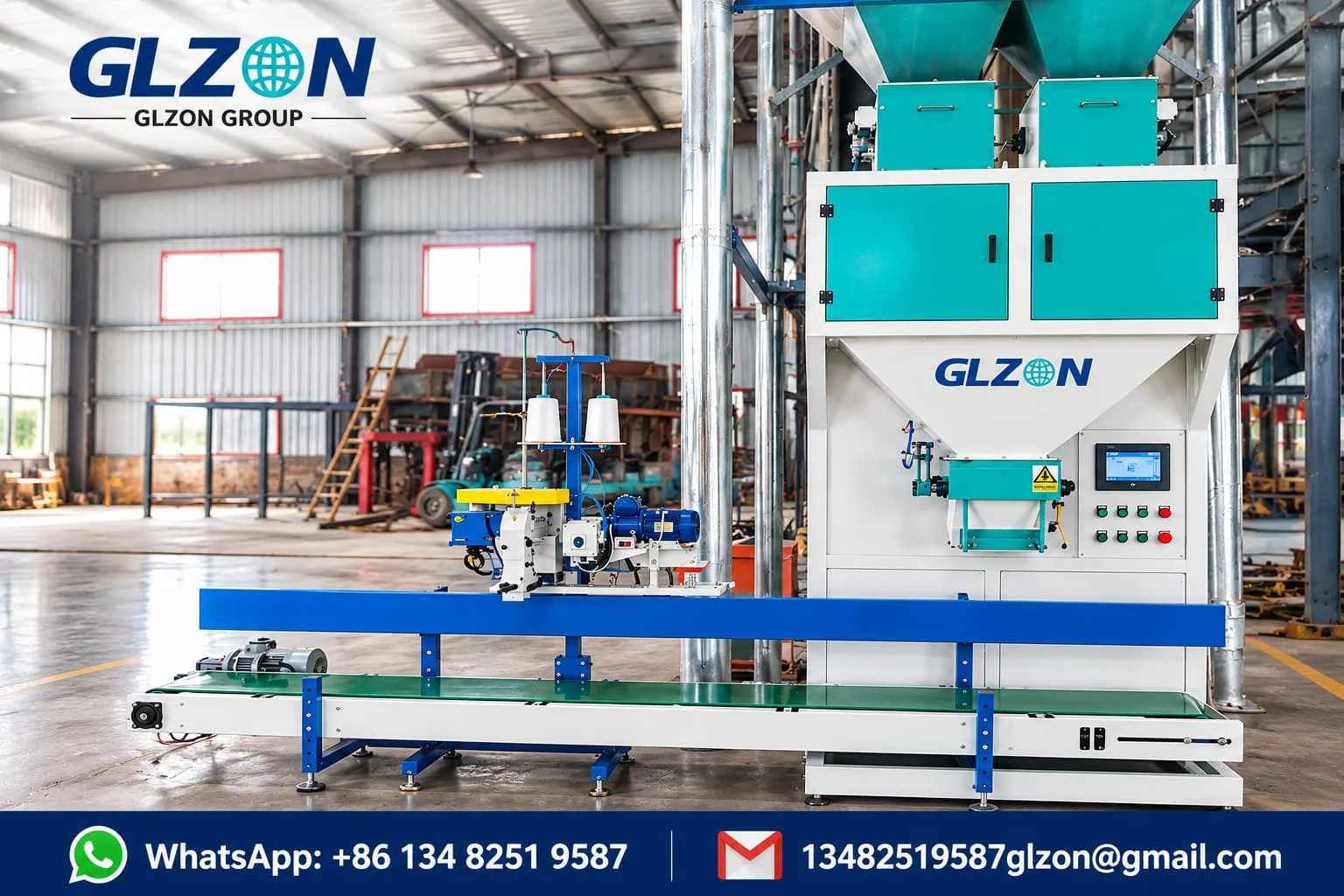
A corn bagging machine is industrial packaging equipment that automatically weighs, fills, and prepares corn for sealing in bags. It helps grain processors, agricultural businesses, and feed manufacturers maintain consistent packaging weights while reducing repetitive manual work.
Modern corn packaging systems can integrate electronic weighing, controlled material feeding, bag filling, conveying, and sewing or sealing into one production process.
At GLZON, we provide industrial weighing and bagging equipment for corn, rice, wheat, seeds, animal feed, and other free-flowing granular materials.
Whether a facility handles harvested corn, processed grain, or agricultural feed ingredients, an appropriately configured bagging system can improve packaging consistency and production efficiency.
What Is a Corn Bagging Machine?
A corn bagging machine is a mechanical or automated system designed to fill predetermined quantities of corn into packaging bags.
It typically combines a feeding mechanism, electronic weighing system, filling spout, bag-holding device, and discharge conveyor.
The equipment can handle different bag sizes and materials, depending on its configuration.
Common applications include:
- Whole corn kernel packaging
- Maize grain bagging
- Animal feed corn packaging
- Agricultural seed packaging
- Processed grain packaging
- Bulk agricultural product handling
A grain bagging machine may also process rice, wheat, beans, barley, and other similar materials when the feeding system and product-contact components suit their properties.
[Image: GLZON automatic corn bagging machine with weighing hopper and conveyor in an industrial grain packaging facility | Alt Text: “GLZON automatic corn bagging machine with electronic weighing and grain filling system”]
How Does a Corn Bagging Machine Work?
A corn bagging machine follows a controlled process that transfers grain from a storage hopper into packaging bags.
Although configurations vary, most weighing and bagging systems operate through the following stages.
1. Corn Feeding and Material Transfer
Corn enters the machine through a feeding hopper or connected conveyor system.
Depending on the equipment design, a gravity feeder, belt conveyor, or other feeding mechanism transfers the corn toward the weighing unit.
For free-flowing corn kernels, gravity feeding is commonly suitable because it allows efficient material movement.
2. Automatic Weighing
An electronic weighing system measures the corn according to a preset target.
Load cells transmit weight information to a controller, which regulates feeding and determines when to stop the flow.
Some systems use coarse and fine feeding stages to improve weight control near the final target.
3. Bag Positioning and Filling
The operator or automatic bag-handling system positions an empty bag beneath the filling spout.
Once the bag is secured, the machine transfers the measured corn into the packaging container.
A properly designed filling spout helps control product discharge and reduce spillage.
4. Bag Conveying
After filling, the machine releases the bag onto a conveyor.
The conveyor transports the filled bag toward the closing station. This reduces the need for repeated manual lifting and carrying.
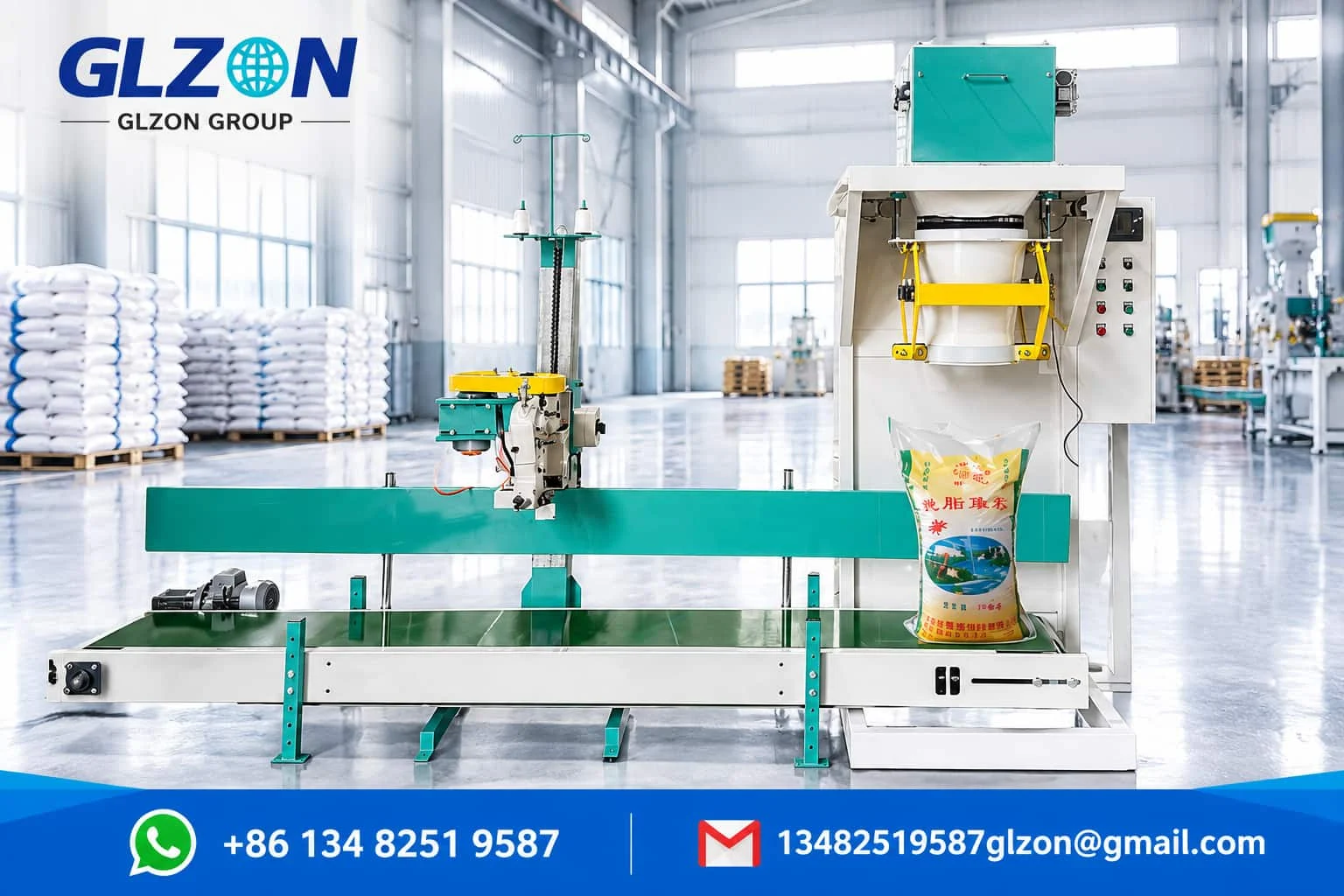
5. Bag Sewing or Sealing
A grain bag sewing machine closes suitable woven polypropylene or paper bags using industrial stitching.
Alternatively, a compatible heat-sealing system can close bags made with heat-sealable materials.
The finished bags can then move to inspection, palletizing, or storage.
Main Features of an Automatic Corn Bagging Machine
Industrial corn packaging equipment can incorporate several features to improve filling consistency and simplify daily operations.
Electronic Weighing System
Digital weighing technology monitors the target filling weight and supports repeatable dosing.
Furthermore, adjustable weight settings allow compatible equipment to handle different packaging formats.
Automatic Feeding Control
Controlled feeding helps maintain stable material flow from the storage hopper into the weighing system.
As a result, operators can manage the packaging process with fewer manual feeding adjustments.
Adjustable Filling Capacity
Different corn packaging operations use different bag weights.
For example, grain packaging equipment may be configured for 5 kg, 10 kg, 25 kg, or 50 kg bags. However, the supported weight range depends on the individual machine.
Conveyor Integration
A conveyor moves filled bags between processing stations.
Consequently, manufacturers can connect weighing, filling, sewing, and downstream handling equipment within the same production line.
PLC and HMI Controls
Depending on the configuration, a programmable logic controller (PLC) and human-machine interface (HMI) can provide:
- Target weight adjustment
- Machine operation monitoring
- Production counting
- Alarm information
- Equipment status display
- Packaging parameter management
These functions help operators monitor and manage the bagging process.
Types of Corn and Grain Bagging Equipment
Different production environments require different levels of automation.
The following equipment categories commonly serve agricultural and grain packaging operations.
| Equipment Type | Main Function | Typical Application |
|---|---|---|
| Semi-Automatic Grain Bagging Machine | Automatic weighing and filling with operator-assisted bag handling | Small and medium grain processing plants |
| Automatic Corn Bagging Machine | Integrated feeding, weighing, filling, and compatible automated handling | Continuous corn packaging |
| Grain Bag Filling Machine | Measured filling of grain into open-mouth bags | Corn, wheat, rice, and seeds |
| Grain Bag Sewing Machine | Stitching filled bag openings | Woven polypropylene and suitable paper bags |
| Rice Bagging Machine | Weighing and packaging rice or similar granules | Rice mills and grain packaging facilities |
| Grain Collecting and Bagging Machine | Combines or connects grain collection and bagging operations | Agricultural grain handling |
Semi-Automatic Grain Packaging Equipment
Semi-automatic systems typically require an operator to position empty bags.
However, the machine controls the weighing and filling stages.
This arrangement suits production environments that need reliable weight control without fully automated bag handling.
Fully Automatic Grain Packaging Systems
Fully automatic systems can combine bag feeding, weighing, filling, conveying, and closing.
In addition, downstream equipment can perform checkweighing, palletizing, and wrapping.
These integrated systems help reduce repeated manual handling in continuous production.
[Image: Automatic grain bagging equipment filling corn kernels into 25kg and 50kg woven bags | Alt Text: “Automatic corn bagging machine and grain bag filling equipment for agricultural packaging”]
What Materials Can a Corn Bagging Machine Package?
A corn bagging machine can serve several agricultural applications when its feeding system, construction, and controls are suitable.
Corn and Maize
Whole corn kernels generally flow more easily than finely ground corn.
Therefore, a gravity-feed bagging system may be suitable for filling dry corn kernels into woven or other compatible bags.
Rice and Wheat
A compatible rice bagging machine uses electronic weighing and controlled filling for grain packaging.
Likewise, some grain filling systems can process wheat and similar cereals.
Animal Feed
Manufacturers commonly package feed ingredients and feed pellets in industrial bags.
However, feed texture, moisture, and particle size influence the appropriate feeding mechanism.
Seeds and Beans
Agricultural seed packaging may require gentle material transfer to limit product damage.
As a result, equipment design should consider drop height, feeding speed, and material handling.
Corn Flour and Ground Corn
Ground corn behaves differently from whole kernels.
A corn grinder bagger operation may connect grinding equipment to a separate powder weighing and bagging system.
However, a standard corn grain filler does not automatically include grinding capability.
Fine ground material may require additional dust control and different feeding equipment.
Corn Bagging Machine vs Farm Grain Bagger
The term grain bagger describes two different equipment categories.
Industrial corn bagging machines generally package measured quantities of grain into commercial bags.
In contrast, agricultural grain baggers may transfer harvested grain into very large flexible storage bags in the field.
Neeralta Grain Bagger
A Neeralta grain bagger is agricultural equipment designed for on-farm grain storage.
It loads harvested grain into long storage bags instead of preparing individual 25 kg or 50 kg commercial packages.
RENN Grain Bagger
Similarly, a RENN grain bagger supports high-capacity agricultural grain storage.
Its function differs from that of an industrial weighing and bagging machine used in a packaging plant.
Therefore, the two equipment categories serve different stages of agricultural material handling.
For manufacturers that need retail, wholesale, or industrial packaged corn, a commercial weighing and bagging system is the relevant equipment category.
Corn Bagging Machine Production Capacity
The required output depends on bag weight, feeding speed, operator involvement, and equipment configuration.
Manufacturers normally express production capacity as bags per hour or tonnes per hour.
For example, the following table shows the theoretical number of bags required to package 2,500 kg of corn each hour.
| Target Bag Weight | Theoretical Bags per Hour | Material Throughput |
|---|---|---|
| 10 kg | 250 | 2.5 tonnes/hour |
| 25 kg | 100 | 2.5 tonnes/hour |
| 50 kg | 50 | 2.5 tonnes/hour |
These figures illustrate the relationship between bag weight and required packaging speed. They are not guaranteed performance specifications for a particular GLZON machine.
Actual output depends on feeding time, bag handling, material flow, closing operations, and production interruptions.
Grain Bag Sewing and Sealing Systems
Reliable bag closing helps keep packaged corn contained during transportation and storage.
Two common closing methods are industrial sewing and heat sealing.
Grain Bag Sewing Machine
A sewing machine closes the upper opening of compatible filled bags with stitching thread.
Manufacturers commonly use this method for woven polypropylene bags and suitable paper sacks.
In addition, an automatic conveyor can move bags through the sewing station.
Rice Bag Sealing Machine
A rice bag sealing machine typically uses an appropriate sealing method for the selected bag material.
For heat-sealable bags, temperature, pressure, and sealing time influence seal quality.
However, ordinary woven polypropylene bags may require stitching or a compatible sealing construction.
Consequently, the bag-closing method must match the packaging material and product requirements.
GLZON Corn and Grain Bagging Solutions
At Shanghai GLZON Equipment Co., Ltd., we offer customizable industrial filling, weighing, and packaging equipment for agricultural and granular materials.
Our relevant packaging solutions include:
- Automatic grain weighing and filling equipment
- Corn and rice bagging machines
- Open-mouth bag filling systems
- Bag sewing and sealing equipment
- Industrial conveying systems
- Automatic bagging and palletizing lines
GLZON’s gravity bagging machine range includes equipment intended for maize, wheat, rice, seeds, beans, animal feed, and other granular materials.
We recommend matching each machine configuration to the material’s flow characteristics, bag dimensions, target weight, and required production output.
Integrated Grain Packaging Lines
A grain processing facility may integrate several machines into one coordinated production system.
For example, a packaging line may consist of:
- Grain storage or buffer hopper
- Feeding and conveying equipment
- Electronic weighing unit
- Automatic bag filling machine
- Filled-bag conveyor
- Bag sewing or sealing machine
- Optional checkweighing and palletizing equipment
Together, these components create a continuous material flow from the storage hopper to the finished packaging stage.
Learn more about our automatic rice and grain bag packing solutions and open-mouth grain filling machines.
Frequently Asked Questions About Corn Bagging Machines
What is a corn bagging machine used for?
A corn bagging machine weighs and fills corn into packaging bags. Depending on its configuration, the equipment can also support conveying, sewing, sealing, and automated packaging operations.
Can one grain bagging machine package corn, rice, and wheat?
Yes. Some grain bagging equipment can handle corn, rice, wheat, and similar free-flowing materials. However, the feeder, weighing settings, product-contact surfaces, and filling configuration must suit each product.
Can a corn bagging machine fill 25kg and 50kg bags?
Yes, compatible industrial bagging machines can package both 25 kg and 50 kg bags. The machine must support the required weight range and bag dimensions.
What is the difference between a grain bag filling machine and a grain bag sewing machine?
A grain bag filling machine measures and dispenses material into bags. A grain bag sewing machine closes filled bags using industrial stitching. Both machines can operate together in an integrated packaging line.
Conclusion: Improve Corn Packaging Efficiency with GLZON
A corn bagging machine is an important part of modern grain processing and agricultural packaging operations.
By integrating controlled feeding, electronic weighing, bag filling, conveying, and compatible closing systems, manufacturers can improve packaging consistency and reduce repetitive handling.
Whether your production line packages corn, rice, wheat, animal feed, or other granular agricultural products, GLZON provides customizable industrial bagging solutions.
Contact GLZON for Corn and Grain Packaging Equipment
Shanghai GLZON Equipment Co., Ltd.
Website: www.baggingline.com
WhatsApp: +86 134 8251 9587
WhatsApp Direct: wa.me/8613482519587
E-mail: 13482519587glzon@gmail.com
Contact us with your material, bag weight, and required production capacity to discuss a suitable machine configuration.