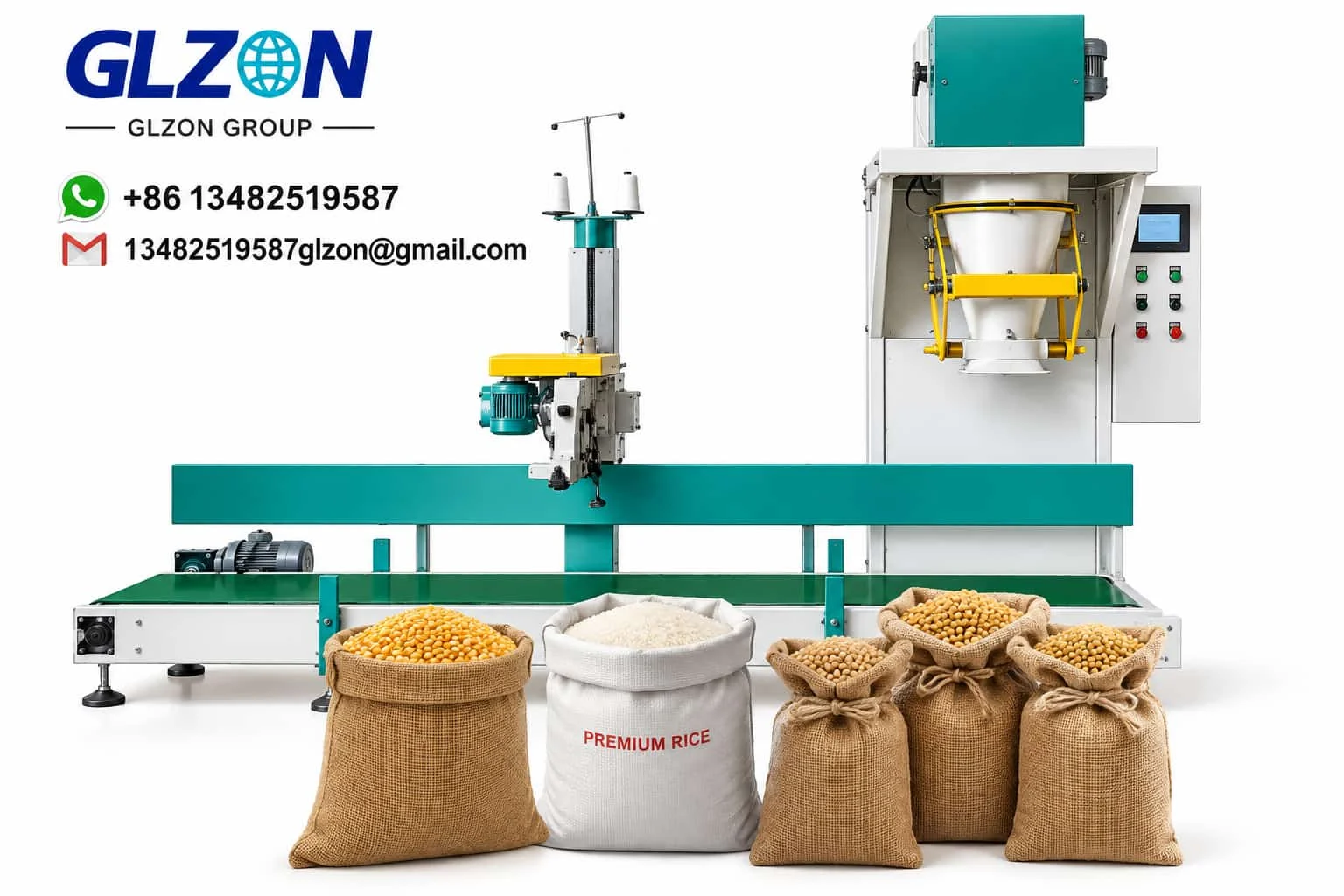
A granule packing machine helps manufacturers weigh, fill, and pack free-flowing granular products quickly and accurately. It works well with rice, grains, seeds, beans, animal feed, fertilizer, plastic pellets, and many other granular materials.
Moreover, manufacturers can choose different machine configurations according to the product, bag size, target weight, and required packing speed. Therefore, both small factories and large production plants can use this type of equipment.
Our granule packing solutions can support common bag weights such as 10 kg, 20 kg, 25 kg, and 50 kg.
What Is a Granule Packing Machine?
A granule packing machine measures a preset amount of granular material and fills it into a bag.
First, the feeding system moves the material into the weighing unit. Next, the machine measures the required weight. Then, it releases the product into the bag.
After filling, the conveyor moves the bag to the next process. For example, you can add a bag sewing machine or heat sealer.
A complete system may include:
- Material feeding system
- Electronic weighing system
- Bag clamping device
- Open-mouth bag filling
- Granule filling machine
- Conveyor
- Bag sewing machine
- Heat sealing machine
- Dust collection system
- Automatic palletizing system
As a result, customers can build a complete packing line instead of using separate manual equipment.
Applications of Granule Packing Machines
A granule packing machine can handle many types of dry and free-flowing materials.
Rice Packing
A rice packing machine weighs and fills rice into bags of different sizes. Therefore, rice mills, grain factories, food processing plants, and exporters can use it for daily production.
Common bag weights include:
- 5 kg
- 10 kg
- 20 kg
- 25 kg
- 50 kg
In particular, 25 kg rice packing machines and 50 kg rice packing machines are popular for industrial packing.
Grain Packaging
Besides rice, the equipment can pack many other grains.
For example:
- Wheat
- Corn
- Maize
- Barley
- Millet
- Oats
- Beans
- Lentils
Because the machine uses a controlled weighing system, it can help maintain a stable filling weight from bag to bag.
Seed Packaging
A granule filling system can also pack agricultural seeds.
Common examples include:
- Corn seed
- Wheat seed
- Soybean seed
- Sunflower seed
- Vegetable seed
However, seed size and flow characteristics can affect the feeding system. Therefore, customers should provide a product sample or detailed material information before machine selection.
Animal Feed Packing
Feed producers can use a granule packing machine for many feed products.
For instance:
- Poultry feed
- Cattle feed
- Fish feed
- Pellet feed
- Pet food granules
Additionally, the system can connect with conveyors and bag sewing equipment for continuous production.
Fertilizer Packing
Many fertilizer producers also use granule bagging equipment.
The system can pack dry granular fertilizer into industrial bags. However, some fertilizers may cause corrosion. Therefore, the machine material should match the product characteristics.
Plastic Granule Packing
Plastic manufacturers can use the machine for:
- Plastic pellets
- Resin granules
- Polymer pellets
- Recycled plastic granules
In addition, a suitable weighing system can help reduce product waste during packing.
How Does a Granule Packing Machine Work?
The working process is simple and easy to understand.
1. Material Feeding
First, the material enters the hopper.
Then, the feeding unit moves the granules toward the weighing section.
2. Automatic Weighing
Next, the weighing controller measures the required amount.
Usually, the machine uses fast feeding at the beginning. After that, it changes to slower feeding when the weight approaches the target.
As a result, the system can improve filling control.
3. Bag Clamping
The operator places an empty bag below the filling outlet.
Then, the bag clamp holds the bag in position.
For a fully automatic production line, an automatic bag feeding system can also handle this process.
4. Granule Filling
After the machine reaches the target weight, it releases the measured product into the bag.
Therefore, the operator does not need to weigh every bag manually.
5. Bag Discharge
Once filling finishes, the machine releases the bag.
Next, the conveyor moves it toward the sealing or sewing station.
6. Bag Closing
Finally, the packing line closes the bag.
Depending on the bag material, customers can choose:
- Bag sewing
- Heat sealing
- Folding and sewing
- Continuous sealing
Therefore, the final configuration depends on the type of bag you use.
Automatic Granule Packing Machine
An automatic granule packing machine can reduce manual work and improve production efficiency.
Compared with manual packing, an automatic system offers several benefits.
For example, it can provide:
- Faster production
- Stable filling weight
- Lower labor requirements
- Simple operation
- Easy weight adjustment
- Conveyor integration
- Automatic bag closing
- Optional palletizing
Moreover, customers can customize the machine according to their factory layout and production target.
25kg and 50kg Granule Packing Machine
Many industrial customers need 25 kg and 50 kg granule packing machines.
These machines can pack products such as:
- Rice
- Grain
- Animal feed
- Fertilizer
- Beans
- Seeds
- Plastic pellets
- Sugar granules
However, bag weight alone does not determine the machine configuration.
For example, rice and fertilizer may both use 25 kg bags, but their flow characteristics can be very different.
Therefore, we normally confirm several details before recommending equipment.
These include:
- Product name
- Bulk density
- Target bag weight
- Bag dimensions
- Bag material
- Required packing speed
- Closing method
- Power supply
- Compressed air requirements
With this information, we can select a more suitable feeding and weighing system.
Granular Filling Machine vs Granule Packing Machine
Customers often search for both granular filling machine and granule packing machine.
Although the terms are similar, they can describe different parts of the packing process.
A granular filling machine mainly measures and fills granular products.
In contrast, a granule packing machine may include additional equipment such as:
- Bag clamps
- Conveyors
- Sewing machines
- Heat sealers
- Bag handling equipment
Therefore, a granular filling machine can form one part of a complete granule packing line.
Main Parts of a Granule Packing Machine
Feeding System
The feeding system moves material from the hopper toward the weighing unit.
Moreover, the feeding method can change according to material flow.
Weighing System
The weighing system measures the required amount of product.
Then, the controller stops the feeding process when it reaches the preset target.
Bag Clamp
The bag clamp holds the bag securely during filling.
As a result, the material can enter the bag more smoothly.
Control System
The control panel allows the operator to adjust important settings.
For example:
- Target weight
- Feeding speed
- Filling parameters
- Calibration
- Production settings
Therefore, operators can quickly adjust the machine when production requirements change.
Conveyor
After filling, the conveyor carries the bag to the next station.
For example, it can move the bag to a sewing machine, sealer, check weigher, or palletizing system.
Benefits of a Granule Packing Machine
Higher Packing Efficiency
First, automatic weighing reduces manual work.
As a result, manufacturers can pack more bags in less time.
More Consistent Filling
The weighing system controls each filling cycle.
Therefore, it helps reduce large weight differences between bags.
Lower Labor Requirements
Workers no longer need to manually weigh every bag.
Instead, they can focus on bag handling, inspection, and production control.
Flexible Bag Weights
Many systems support several filling weights.
For example, the operator may switch between 25 kg and 50 kg production when the machine configuration allows it.
Easy Production Line Integration
A granule packing machine can connect with other equipment.
For instance:
- Bag sewing machine
- Heat sealer
- Conveyor
- Check weigher
- Metal detector
- Palletizer
- Stretch wrapper
Therefore, manufacturers can build a complete automatic packaging line.
How to Choose a Granule Packing Machine
Choosing the right machine requires more than checking the bag weight.
Check the Material
First, confirm what product you need to pack.
Rice, beans, fertilizer, animal feed, and plastic pellets all behave differently during filling.
Confirm Bulk Density
Next, provide the bulk density if possible.
Bulk density affects the hopper, weighing system, and filling speed.
Choose the Bag Weight
Common industrial weights include:
- 10 kg
- 20 kg
- 25 kg
- 50 kg
However, other filling ranges are also possible.
Confirm the Bag Type
Different bags require different closing systems.
Common options include:
- PP woven bags
- Kraft paper bags
- Plastic bags
- Laminated bags
For example, woven bags often use sewing. In contrast, plastic bags may require heat sealing.
Set the Required Capacity
Next, determine how many bags you need to pack per hour.
A small factory may choose a semi-automatic system. However, a high-output factory may need automatic bag feeding, sewing, palletizing, and wrapping.
Consider the Factory Environment
Finally, consider dust, humidity, corrosion, hygiene, and available installation space.
These factors can affect the final machine design.
Rice Packing Machine for 25kg and 50kg Bags
Rice is one of the main applications for a granule packing machine.
A typical rice packing line may use the following process:
Rice Hopper → Automatic Weighing → Bag Filling → Conveyor → Bag Sewing → Finished Bag
For higher automation, customers can also add:
- Automatic bag feeding
- Bag shaping
- Check weighing
- Metal detection
- Robotic palletizing
- Stretch wrapping
As a result, a simple rice filling machine can become a complete automatic rice packaging line.
Why Choose a Customized Granule Packing System?
Every granular product has different properties.
Therefore, one machine setup may not work equally well for every product.
A customized system can consider:
- Material flow
- Bulk density
- Bag weight
- Bag dimensions
- Production capacity
- Factory layout
- Automation level
- Bag closing method
- Electrical standard
As a result, the machine can better match the real production process.
Frequently Asked Questions
What products can a granule packing machine pack?
A granule packing machine can handle many free-flowing products, including rice, grains, beans, seeds, fertilizer, animal feed, and plastic pellets.
Can the machine pack 25kg bags?
Yes. We can configure a 25 kg granule packing machine according to the product, bag type, and required capacity.
Can it pack 50kg rice bags?
Yes. A 50 kg rice packing machine can handle industrial rice and grain packaging when the feeding and weighing system matches the product.
Can I add a bag sewing machine?
Yes. You can connect a bag sewing machine and conveyor after the filling station.
Moreover, you can add other equipment if you need a more automatic line.
Can one machine fill different weights?
In many cases, yes. Operators can change the target filling weight through the controller.
However, the available range depends on the machine and bag dimensions.
Can you customize the machine?
Yes. We can customize the hopper, filling range, conveyor, weighing system, bag closing method, and automation level according to your project.
Get a Granule Packing Machine Solution
If you need a granule packing machine, please send us your product and packaging information.
For the fastest machine selection, provide:
- Product name
- Product photo or video
- Bulk density
- Bag weight
- Bag dimensions
- Bag material
- Required bags per hour
- Sewing or sealing requirements
- Factory power supply
Then, we can recommend a suitable granule packing machine, granular filling machine, rice packing machine, rice packaging machine, or complete bagging line for your production.
Contact us for machine specifications, configuration, videos, and quotation.