
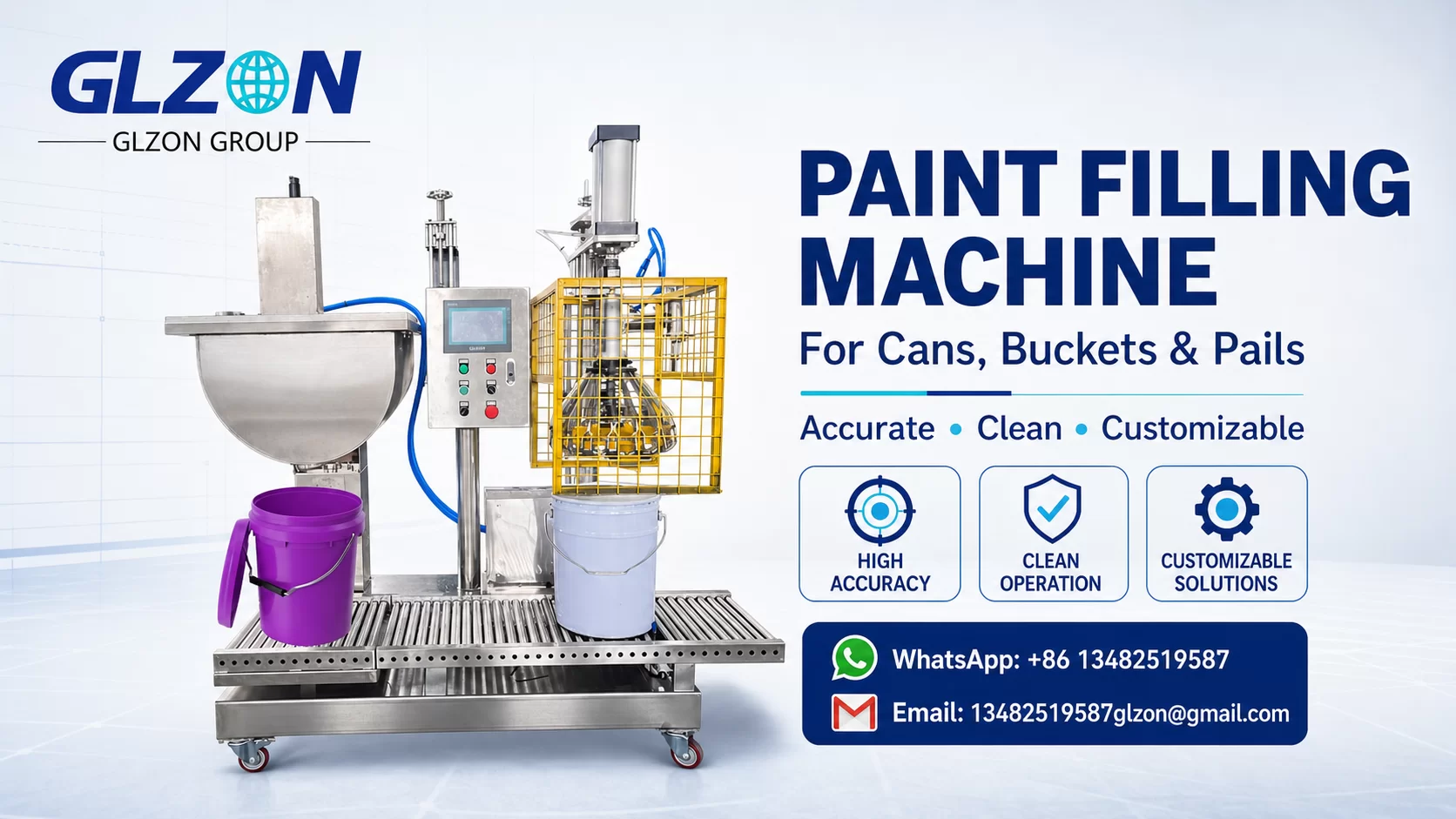
The GLZON GZM-30-1PT is a semi-automatic, weight-based system designed for controlled filling of paint, coatings, ink and other compatible liquid or viscous products. It is suitable for manufacturers that need to fill metal cans, plastic buckets, pails and similar containers while reducing manual weighing, product loss and inconsistent fill quantities.
The standard reference model combines a load-cell weighing system, single filling head, fast and slow filling control, PLC operation and selectable top or bottom-up filling. The published reference filling range is 5–30 kg, with a stated accuracy of up to ±0.2% and a reference output of 120–240 containers per hour. Actual results depend on the product viscosity and density, target weight, product supply, container handling and final machine configuration.
The machine can be supplied as a standalone paint can filling machine or combined with conveyors, lid placement, lid pressing, capping and labeling equipment to create a more complete paint packaging line.
Send us your paint information, container dimensions, required fill weight and target capacity. GLZON will recommend a configuration based on your actual production conditions.
Paint Filling Machine at a Glance
| Item | Reference configuration |
|---|---|
| Model | GZM-30-1PT |
| Machine type | Semi-automatic weighing-type filler |
| Reference filling range | 5–30 kg |
| Reference accuracy | Up to ±0.2%, depending on operating conditions |
| Reference speed | 120–240 containers/hour |
| Filling heads | One head in the reference model |
| Filling control | Fast and slow feed |
| Filling modes | Net weight or gross weight |
| Nozzle movement | Top filling or bottom-up/subsurface filling |
| Suitable containers | Cans, jerry cans, buckets, pails and compatible containers |
| Product-contact options | SUS304, SUS316 or PTFE, selected by compatibility |
| Control | PLC-based automatic filling cycle with manual and automatic modes |
| Power supply | AC 220V or AC 380V, 50 Hz; confirm local standard |
| Reference power | 200 W |
| Air supply | Approximately 0.5 MPa |
| Reference machine size | 1225 × 660 × 1180 mm |
| Optional equipment | Conveyor, lid press, capping and explosion-protected configuration |
All values are reference specifications. The signed technical agreement and final quotation should control the delivered configuration.
What Is a Paint Filling Machine?
A paint filling machine measures and dispenses a target quantity of paint into a container. In a weight-based system, the container sits on a weighing platform fitted with load cells. The controller monitors the increasing weight during filling and closes the filling valve when the programmed target is reached.
For paint and coatings, this approach offers an important advantage: the machine controls the quantity by mass rather than relying only on a timed flow. This is useful when product density, temperature, supply pressure or viscosity can change between batches. A properly configured weighing system can help reduce underfilling and costly product giveaway.
The GZM-30-1PT can operate in two weight modes:
- Net-weight filling: The system tares the empty container and controls the quantity of product added.
- Gross-weight filling: The controller works toward a final total weight that includes the container.
The correct mode depends on the packaging process and quality-control method used by the paint manufacturer.
Why Paint Requires the Correct Filling Technology
Paint is more difficult to package than water-like liquids. Different formulations can have very different viscosity, flow, foaming, solvent, pigment and cleaning characteristics. These factors affect the valve, nozzle, hose, pump, filter, filling speed and product-contact materials.
Viscosity and flow
Thicker paint needs a supply system capable of maintaining stable flow. A pump, pressurized supply or suitable hopper arrangement may be required. If product pressure changes during the filling cycle, output and cut-off behavior can become less consistent.
Foam and splashing
Some coatings trap air or foam when the product falls from the nozzle into an empty container. A bottom-up filling cycle can position the nozzle near the bottom of the container and raise it as the liquid level increases. This reduces the free-fall distance and can help control foam and splashing.
Dripping and stringing
Viscous paint may continue to drip or form a product string after the valve closes. The nozzle design, valve response, product pressure and final slow-fill setting must work together to achieve a cleaner cut-off.
Pigments and particles
Pigmented products or coatings containing solids may require an appropriate valve opening, product line and filter selection. Product details should be reviewed to avoid unnecessary restriction or blockage.
Solvent and flammability hazards
Water-based paint and solvent-based paint do not have the same safety requirements. If a product is flammable or produces hazardous vapor, the buyer must provide the safety data sheet and installation-area classification. Explosion-protected electrical equipment, grounding, ventilation, fume extraction and other controls must be specified for the actual site. A standard machine should never be assumed suitable for a hazardous area without technical confirmation.
How the Net-Weight Filling Cycle Works
The semi-automatic system automates the weighing and dispensing cycle while the operator handles the container.
1. Load the empty container
The operator places a paint can, bucket or pail on the weighing platform and aligns its opening below the filling nozzle.
2. Select the product recipe
The required target weight and filling parameters are selected on the controller. Recipes can be prepared for compatible products and container sizes when included in the machine configuration.
3. Confirm the container and tare
The system checks the scale condition and, in net-weight mode, records the empty-container weight before filling.
4. Start fast filling
The valve opens for the coarse-fill stage. Most of the target quantity is delivered at a higher flow rate to support production efficiency.
5. Change to slow filling
As the measured weight approaches the target, the controller changes to a lower flow rate. This fine-fill stage helps limit overshoot and improve final weight control.
6. Reach the target weight
The controller closes the filling valve at the calculated cut-off point. The final result can be displayed on the weighing instrument.
7. Retract the nozzle
For bottom-up filling, the nozzle follows the programmed lifting sequence and returns to its raised position after filling.
8. Remove and close the container
The operator transfers the filled container to manual lid placement, a lid press, a metal-lug crimper or another compatible capping station.
Top Filling vs. Bottom-Up Filling
The GZM-30-1PT can be configured for conventional top filling or bottom-up/subsurface filling. The product behavior should determine the correct method.
| Filling method | How it works | Best suited to |
| Top filling | The nozzle remains at or near the container opening and fills from above the rising product level | Non-foaming products with controlled splash behavior |
| Bottom-up filling | The nozzle enters the container and rises during filling | Products that foam, splash or require a reduced free-fall distance |
Top filling usually has a simpler cycle and may provide faster handling for products that do not foam. Bottom-up filling gives more control for difficult materials but requires correct nozzle travel, container alignment and cleaning procedures.
The final method should be confirmed through product and container testing.
Fast and Slow Filling for Better Weight Control
Industrial weighing fillers commonly use a coarse-fill and fine-fill sequence. The GLZON machine uses fast and slow feed control for the same practical reason: speed is important during the main part of the cycle, but a lower flow rate is needed near the target.
The transition point and final cut-off must be adjusted for:
- Target filling weight
- Paint viscosity and density
- Product temperature
- Pump or hopper pressure
- Valve and nozzle size
- Product line length
- Required accuracy
- Scale stability
The highest possible flow is not always the best setting. A stable feed and repeatable cut-off normally produce better results than an oversized pump or uncontrolled supply pressure.
Automatic and Semi-Automatic Paint Filling Options
Semi-automatic paint filling machine
The GZM-30-1PT is designed as a semi automatic paint filling machine. The operator loads and removes the container, while the machine performs the weighing and filling cycle.
This configuration is suitable for:
- Small and medium paint factories
- Frequent color or product changes
- Batch production
- Multiple compatible container formats
- Factories with limited floor space
- Buyers upgrading from manual filling
It provides controlled filling without the investment and layout requirements of a fully automatic line.
Automatic paint filling machine
For higher output or lower manual handling, the filling station can be engineered as part of an automatic line. An automatic paint filling machine may include powered conveyors, container detection, automatic indexing, lid handling, lid pressing, capping, labeling and finished-container discharge.
Automatic operation should be considered when:
- Production is continuous
- Container and lid quality are consistent
- The same package runs for longer periods
- Labor reduction is a priority
- Upstream paint supply is stable
- Downstream packaging can match the filler output
The required production capacity should be calculated for the complete line, not only the filling valve. Lid placement, capping, labeling and operator handling can become the limiting steps.
Paint Cans, Buckets and 5-Gallon Pails
The machine can be configured as a paint can filling machine, paint bucket filling machine or 5 gallon pail filling machine. Container compatibility depends on the opening diameter, total height, base dimensions, material, handle position and target fill weight.
Common packages include:
- Metal paint cans
- Plastic paint buckets
- Open-head pails
- One-gallon cans
- Five-gallon pails
- Jerry cans and compatible industrial containers
Before production, the machine must be set so the nozzle enters or aligns with the opening without contacting the rim. For a bottom-up cycle, the nozzle stroke must match the internal container depth.
Send representative empty containers and lids for testing whenever possible. Samples help confirm:
- Nozzle alignment
- Filling height
- Scale and platform fit
- Conveyor guide position
- Handle clearance
- Lid placement
- Lid pressing or crimping performance
Suitable Paints, Coatings and Related Products
Subject to compatibility review, the machine can be considered for:
- Water-based paint
- Emulsion paint
- Latex paint
- Architectural coatings
- Industrial coatings
- Wood coatings
- Primers
- Varnishes
- Printing ink
- Resin products
- Adhesives and glue
- Lubricants
- Asphalt-based products
- Compatible fine chemicals
This list does not mean one standard configuration is suitable for every material. Product-contact parts, seals, hoses, pump, filter, valve, nozzle and electrical protection must be chosen for the actual formulation.
Main Machine Components
Weighing platform and load cells
The platform supports the container while the load cells measure weight throughout the filling cycle. A rigid foundation, correct installation and protection from excessive vibration or conveyor force are important for stable readings.
Filling valve and nozzle
The valve controls fast and slow product flow. The valve opening and nozzle diameter should be selected for the paint viscosity, required capacity and container opening.
Product supply system
The filler needs a continuous and stable product supply. Depending on the material and factory layout, this may use a hopper, diaphragm pump or another compatible feed system. The pump should not be selected by flow rate alone; viscosity, solids, solvent compatibility and cleaning must also be considered.
PLC and weighing controller
The control system manages the filling sequence, weight setpoint, fast/slow transition and final cut-off. It can support manual and automatic operating modes according to the final configuration.
Pneumatic control
Pneumatic components operate relevant valves and nozzle movements. The reference air requirement is approximately 0.5 MPa; final air consumption and quality requirements should be confirmed.
Frame and product-contact parts
The machine frame supports the filling and weighing assemblies. Product-contact options include SUS304, SUS316 or PTFE according to chemical compatibility. Material selection should be confirmed from the paint formulation and safety data.
Standard Features
- Weight-based quantitative filling
- Reference filling range of 5–30 kg
- Single filling head
- Fast and slow filling control
- Net-weight and gross-weight modes
- Top filling and bottom-up filling options
- Real-time weight display
- PLC-based control
- Manual and automatic operating modes
- Adjustable parameters for compatible products
- Emergency-stop protection
- Configurable product-contact materials
- AC 220V or AC 380V power options
- Compact standalone layout
Optional Equipment
The filler can be combined with suitable auxiliary equipment to form a paint packing machine or complete packaging line:
- Product feed pump
- Product hopper or buffer tank
- Infeed and discharge conveyors
- Container positioning device
- Drip tray or drip collection
- Manual lid-placement table
- Pneumatic pail lid press
- Metal pail lug crimper
- Automatic lid feeding and placement
- Automatic capping machine
- Labeling and coding equipment
- Checkweigher
- Explosion-protected configuration
- Fume collection connection
- Customized frame or conveyor height
- Single-head or higher-capacity custom configurations
Every option should be confirmed in the final layout and technical agreement.
Cleaning and Color Changeover
Paint manufacturers often run multiple colors or formulations on one line. Changeover time depends on the product circuit, not only the filling nozzle.
The cleaning plan should consider:
- Product supply tank or hopper
- Pump
- Filter
- Hoses and piping
- Filling valve
- Nozzle
- Drip tray
- Recovery or waste container
When frequent color changes are required, tell the supplier before machine design. Shorter product lines, appropriate connections, accessible product-contact parts and a planned flushing procedure may reduce downtime and cross-contamination.
The cleaning liquid must be compatible with the paint formulation, seals, hose and machine materials. Follow the paint supplier’s safety data and the factory’s waste-disposal rules.
How to Choose the Correct Paint Filling Equipment
To select the correct machine, provide complete application data rather than requesting a price from container volume alone.
1. Product information
- Product name and type
- Water-based or solvent-based formulation
- Viscosity and density
- Operating temperature
- Foaming behavior
- Particle or pigment information
- Safety data sheet
- Required product-contact materials
2. Container information
- Container material
- Container dimensions
- Opening diameter
- Empty-container weight
- Target filling weight
- Lid type
- Photos, drawings and samples
3. Production requirements
- Containers per hour
- Hours per shift
- Number of products and colors
- Frequency of changeover
- Manual, semi-automatic or automatic operation
- Required filling tolerance
4. Factory conditions
- Power supply, frequency and phase
- Compressed-air pressure
- Available floor space
- Product supply location and pressure
- Filling-line direction
- Hazardous-area classification
- Ventilation and environmental requirements
5. Downstream packaging
- Manual or automatic lid placement
- Lid pressing, crimping or capping
- Labeling and coding
- Checkweighing
- Case packing or palletizing
Paint Filling Machine Price
The paint filling machine price depends on the material, filling range, required speed and level of automation. A basic semi-automatic filler costs less than an automatic line with conveyors, lid feeding, capping and labeling.
Important price factors include:
- Number of filling heads
- Top or bottom-up filling
- Valve and nozzle design
- Pump or product supply system
- SUS304, SUS316, PTFE or other compatible materials
- Conveyor length
- Lid pressing or capping equipment
- Electrical brands and local power standard
- Explosion-protected components
- Fume extraction or containment
- Factory testing requirements
- Shipping destination and trade terms
For an accurate quotation, send the material safety data, container and lid information, target weight, required output and destination. GLZON can then prepare a technical configuration instead of offering an unsuitable general price.
Why Choose GLZON as Your Paint Filling Machine Manufacturer?
Shanghai Guangzhi Automation Equipment Co., Ltd. supplies GLZON industrial weighing, filling and packing equipment from Shanghai, China. Our paint filling solutions are selected around the customer’s material, package and production process.
Customers can request:
- Semi-automatic 5–30 kg paint filling equipment
- Customized filling ranges
- Top or bottom-up filling
- Net-weight filling control
- Paint can, bucket and pail applications
- Conveyor and line-layout design
- Lid pressing and capping integration
- Electrical configuration for the destination country
- Product and container testing
- Technical documentation for the agreed machine
Our objective is to match the machine to the real filling application and provide a clear technical proposal before production.
Frequently Asked Questions
What is the best filling system for paint?
A net-weight system is a practical choice for many paint and coating applications because it controls the quantity by measured mass. The final selection depends on viscosity, container size, required output and filling tolerance.
What is the filling range of the GZM-30-1PT?
The published reference filling range is 5–30 kg. Other requirements should be reviewed separately and confirmed in the technical agreement.
What filling accuracy can the machine achieve?
The reference accuracy is up to ±0.2%. Actual accuracy depends on product flow, viscosity, target weight, feed stability, scale installation, operating environment and correct parameter adjustment.
How fast can the paint filling machine operate?
The reference output is 120–240 containers per hour. Actual production speed depends on fill weight, viscosity, nozzle size, product supply, top or bottom-up filling, operator handling and downstream lid closing.
Can the machine fill high-viscosity paint?
It can be configured for viscous products, but the valve, nozzle, hose and pump must be selected for the material. Send viscosity, density, temperature and particle information for confirmation.
What is the difference between top filling and bottom-up filling?
Top filling dispenses product from near the container opening and is suitable for controlled, non-foaming applications. Bottom-up filling lowers the nozzle into the container and raises it as filling progresses, reducing free fall, splashing and foam.
Can it fill 5-gallon paint pails?
Yes, a 5-gallon pail can be evaluated within the machine’s weight and dimensional limits. Provide the pail dimensions, opening diameter, target weight and lid sample for confirmation.
Can the same machine fill different cans and buckets?
Yes, compatible sizes may be handled after adjusting the nozzle height, container position and filling recipe. Very different containers may require change parts or a customized platform and conveyor.
Is a pail lid press available?
Yes. A pneumatic lid press, metal-lug crimper or compatible capping system can be added according to the lid design.
Is an explosion-proof model available?
An explosion-protected configuration is available on request. Suitability must be confirmed using the product safety data and the factory’s hazardous-area classification. Explosion protection should never be assumed from the word “paint” alone.
Is this an automatic or semi-automatic machine?
The GZM-30-1PT reference model is semi-automatic: the operator handles the container while the weighing and filling cycle is automatic. Fully automatic lines with conveyors and downstream equipment can be engineered for higher production requirements.
Can the machine be customized for local voltage?
The reference power options include AC 220V and AC 380V at 50 Hz. Confirm the destination voltage, frequency and phase before ordering.
What information is required for a quotation?
Send the paint name, safety data, viscosity, density, container dimensions, lid type, filling weight, required containers per hour, voltage, destination and required conveyor or capping equipment.
Request a Paint Filling Machine Quotation
Looking for a reliable paint filling machine for sale for cans, buckets or 5-gallon pails? Send GLZON:
- Paint or coating name
- Safety data sheet
- Viscosity and density
- Container and lid photos
- Container dimensions and opening diameter
- Target filling weight
- Required containers per hour
- Preferred automation level
- Power supply and air pressure
- Destination city and country
- Required conveyor, lid press, capping or labeling equipment
We will review your application and prepare a suitable machine configuration, technical proposal and quotation.
Contact GLZON today to discuss your paint filling and packaging project.
hello i want to buy paint filling machine